# Google Is Paying Publishers for AI Answers
> Google now pays publishers when content shapes Gemini and AI Overviews. How the Search Console pilot works, why payouts look tiny, and what to do.
Source: https://capitalandcompute.net/blog/google-ai-contribution-pilot-publishers/
Published: 2026-09-18
Updated: 2026-10-13
Google started paying publishers when their pages shape its AI answers. The program is called the AI contribution pilot, it lives inside Search Console, and it covers Gemini, AI Overviews, and AI Mode. Early payouts look small, the formula is undisclosed, and publishers are split on whether it is a real revenue path or a legal hedge.
This is the first time Google has tested direct payment tied to inference-time use of publisher content, not clicks. That precedent matters even if the current checks do not move any budget.
Key takeaways
* The AI contribution pilot pays when Google judges a page "significantly" shaped an AI-generated response in Gemini, AI Overviews, or AI Mode.
* Participants see a monthly earnings widget in Search Console with some history but no per-page formula or rate card.
* Only generation-phase influence qualifies. Pages that merely confirm facts or get linked after the answer is drafted do not earn.
* Digiday reported dozens of publishers approached, with small and mid-size sites most likely to join; early returns are described as tiny against ad revenue.
* The pilot sits beside the Aug 2026 generative-AI performance reports, which show impressions only, and beside Cloudflare and TollBit pay-per-use rails.
## What the pilot actually does
**What is the Google AI contribution pilot? It is a limited Search Console program that accrues earnings when a publisher page contributes significantly to an AI-generated response in participating products, currently Gemini, AI Overviews, and AI Mode.** Joining adds an earnings panel to Search Console. Leaving is a settings toggle. Payments can differ from accrued earnings after tax withholding or local payment thresholds.
The screenshot below shows the entry point as it appears in Search Console: an Overview card inviting the site owner to start earning, with the key sentence about significant contribution stated up front.
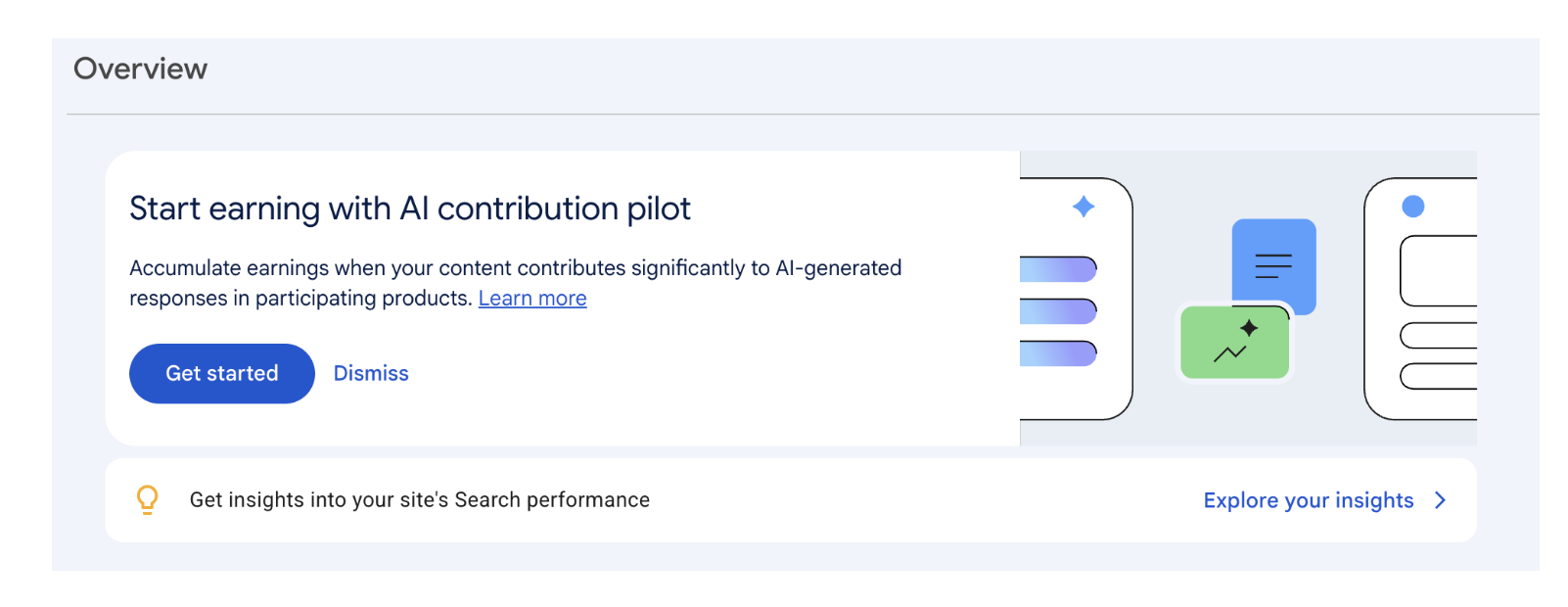
The AI contribution pilot entry card in Search Console. The operative phrase is 'contributes significantly': judged influence on the generated response, not raw crawl counts or citation counts.Source: Google Search Console (author screenshot, September 2026)
The mechanics come from the pilot help text quoted in [Search Engine Roundtable coverage of the AI contribution pilot](https://www.seroundtable.com/google-al-contribution-pilot-42076.html), 2026 secondary reporting on the launch. Three points in that text do the real work. First, the pilot focuses on the generation phase where web content can shape what the response says. Second, content that only confirms facts does not qualify. Third, links added after the response is generated do not qualify either. That distinction separates this pilot from a simple citation bounty. A page can be linked inside an AI answer and still earn nothing if Google judges it did not shape the wording.
Google confirmed the program to Digiday as an early-stage learning pilot to test rewarding high-quality content, on top of traffic and tools it already provides, as reported in [Digiday reporting on the pay-per-value licensing program](https://digiday.com/media/google-rolls-out-pay-value-ai-licensing-program-to-publishers/), a September 2026 trade report based on anonymous publisher sources. The company pointed back to a June policy post describing tests of a model where website content helps keep generative answers fresh and accurate through grounding. Digiday could not confirm a final participant count but reported at least dozens of publishers approached, with appeal concentrated among small and mid-size publishers and widening beyond news.
## Why publishers inside the tent stay anyway
Two anonymous pilot participants told Digiday they would rather be inside the program than outside it, even with thin data. One wished for more transparency but called the precedent of direct payment meaningful. The other framed the pilot as an early test of a marketplace for inference data, where the Search Console feedback loop that taught publishers what ranks in search could repeat for what matters in AI inference. Google is holding weekly calls with some partners, which both described as collaborative.
That framing is worth taking seriously. For twenty years publishers optimized against a visible scoreboard: queries, positions, clicks. The AI answer economy removed the scoreboard. A panel that says which content Google values at generation time, even without a rate card, restores part of it. The publishers who learn that mapping first gain months on competitors who wait for a finished product.
The economics behind the urgency are documented in our [analysis of AI search disruption economics](/blog/ai-search-disruption-economics/). A 2026 field experiment from the Indian School of Business and Carnegie Mellon put the causal click loss at 39.8% on queries where AI Overviews appear, and Pew Research Center data from 2025 showed click-through falling from 15% without a summary to 8% with one. When the click disappears into the answer, payment tied to the answer is the only replacement that matches the loss at its source.
## Why critics call the checks tiny and the box black
The same Digiday report carries the other side in blunt terms. One source close to the situation described early returns as pocket change relative to advertising revenue. A separate publishing executive who saw offered numbers called them lowball figures that did not clear the threshold to opt in, and said negotiations were ongoing. No published rate, no per-page accounting, and no formula means no publisher can check whether the number is fair. One executive warned that joining could weaken collective pressure for better terms, since Google can point to the program as proof it already compensates use in AI summaries.
That opacity is the central objection. Luke Stillman, managing director of Madison and Wall, told Digiday the pilot is a cheap way to reduce legal, regulatory, and reputational risk at once, while giving smaller publishers incremental upside they could not negotiate alone. David Buttle, founder of the publisher AI coalition Spur and of media consultancy DJB Strategies, went further and called per-use payments a strategic hedge: Google does not want a market priced on actual usage of journalism in AI, because that logic would spread to the whole search model that has historically avoided paying for publisher content. In his reading the pilot tests the plumbing for a world Google hopes never arrives, while establishing the useful precedent that usage events carry value and deserve a return path.
Both quotes are opinion reported through Digiday, not independent findings, and they should be read that way. But the structural point stands on its own. A marketplace with one buyer, one undisclosed pricing function, and no itemized statement is not a market. It is a transfer the buyer sets. Until Google publishes how significance is scored and what each qualifying event pays, every participant is pricing blind.
Note
Do not confuse the earnings widget with the visibility report. The August 2026 generative-AI performance reports show impressions by page, country, device, and date. The pilot widget shows money. An impression does not imply a qualifying contribution, and a qualifying contribution need not come with a click.
## Visibility is now measured, money is not yet explained
Google launched dedicated [Search Generative AI performance reports in Search Console](https://developers.google.com/search/blog/2026/06/gen-ai-performance-reports), a June 2026 Google Search Central announcement, initially for a subset of sites, then rolled them worldwide by August 31, 2026\. The [Search Console help page for the generative AI performance report](https://support.google.com/webmasters/answer/16984139?hl=en), current Google documentation, defines what they show: impressions in AI Overviews and AI Mode, grouped by pages, countries, dates, and for Search also devices. They do not show queries or a per-answer accounting, and site owners who opt out of AI surfaces lose the impressions and any downstream visits from those surfaces. Google states the opt-out is not used as a ranking signal outside those AI features.
One pilot publisher told Digiday the new AI-surface impression counts came in higher than expected and tracked the traffic lost from traditional search and Discover closely. That match is exactly why the compensation question sharpened in August. Publishers can now see the exposure moving from blue links into generated answers, on a dashboard Google itself provides, while the payment for that exposure sits on a separate dashboard with no formula.
The practical move is to report the two series side by side. Track AI impressions per page against classic clicks per page from the same Search Console property, week by week, and watch which pages shift from earning visits to earning only exposure. Those are the pages where pilot earnings, TollBit bot-paywall revenue, or direct licensing would need to close the gap. Our [publisher revenue playbook for the AI search era](/blog/publisher-revenue-playbook-ai-search-era/) lays out the six-part version of that response, from revenue-per-session tuning to owned channels.
## Where Google fits beside Cloudflare, TollBit, and x402
Google is the fourth pay-per-use rail, not the first. Cloudflare Pay Per Use, live since July 1, 2026, pays when publisher content appears in an AI answer rather than per crawl. TollBit connects about 7,000 publisher sites with AI companies at rates that [Presenc AI analysis of TollBit publisher licensing](https://presenc.ai/research/tollbit-publisher-licensing-2026), April 2026 secondary analysis, placed at $0.001 to $0.10 per fetch for general content and up to $0.20 for premium news, with nearly 20% of its network earning between hundreds and tens of thousands of dollars monthly per [Digiday reporting on the Arc XP and TollBit integration](https://digiday.com/media/the-washington-posts-arc-xp-adds-tollbit-to-help-publishers-make-money-from-ai-bot-traffic/), April 2026 trade reporting. The x402 open payment standard, contributed to the Linux Foundation by Coinbase in April 2026, provides the machine-to-machine payment message underneath, with over 100 million payments processed since May 2025 per [Alchemy documentation on x402 payments](https://www.alchemy.com/blog/how-x402-brings-real-time-crypto-payments-to-the-web), 2026 vendor documentation.
Google differs on two axes. It pays on judged value rather than counted fetches or appearances, and it is also the search platform that decides both the judgment and the traffic outcome. That dual role is why small publishers join (no sales team needed, money for content already produced) and why larger ones hesitate (no audit trail, no price discovery, possible precedent cost). A mid-size specialist site with original data or local expertise is the natural pilot member: too small to strike a bilateral OpenAI-style deal, specific enough that its pages plausibly shape answers.
For Capital & Compute readers the parallel is direct. The same grounding logic that decides whether a publisher page earns also decides whether independent analysis like this site gets cited inside AI answers. Our [guide to AI visibility tools](/blog/best-ai-visibility-tools/) covers how to check that citation footprint with outside tooling while Search Console only shows impressions.
## What to do if the invite appears
Treat the pilot as a paid experiment, not a strategy. Accept it if invited, since opting out forfeits both the earnings and the learning about what Google scores as significant. Keep the rest of the revenue plan unchanged: session-RPM tuning on remaining visits, email capture that survives algorithm shifts, and bot-paywall coverage through Cloudflare or TollBit so Google is not the only bidder for machine use of the same pages.
Three checks before counting any of it as revenue. First, reconcile the monthly earnings figure against the AI-impression counts for the same property and period, and note the ratio in plain dollars per thousand AI impressions so later months are comparable. Second, tag which high-impression pages never produce a qualifying event, since those reveal what Google’s scorer does not value. Third, keep the paper trail: dates, dashboard figures, and any written rate hints from partner calls, because a future collective negotiation or regulatory filing will ask exactly what was paid for what.
## Bottom line
Google conceding that some AI responses owe publishers money is the news. The amount, the formula, and the audit trail are still missing. Join the pilot to learn and to get paid something for value already created, but judge it the way any buyer offer deserves: against measured exposure lost, against the other three payment rails, and against the cost of letting one counterparty set the price of your work without showing its math.
## Sources
* Jessica Davies and Sara Guaglione (2026). _Google rolls out pay-per-value AI licensing program to publishers_. Digiday.
* Barry Schwartz (2026). _Google tests paying publishers for using its content in AI Mode, AI Overviews and Gemini_. Search Engine Land.
* Barry Schwartz (2026). _Google Search Console testing paying publishers for use of content in AI, AI contribution pilot_. Search Engine Roundtable.
* Google Search Central (2026). _Introducing Search Generative AI performance reports in Search Console_. Google for Developers.
* Google (2026). _Generative AI performance report (Search)_. Search Console Help.
* Prabhanu Kumar Das (2026). _Google rolls out AI contribution pilot to compensate publishers appearing in AI responses_. Medianama.
* Google (2026). Author screenshot of Google Search Console AI contribution pilot entry card, September 2026\. Original image filed as `/images/google-ai-contribution-pilot-search-console.png`.