Claude Opus 5: Pricing, Benchmarks, and Cost
Claude Opus 5 ships at $5/$25 per million tokens with an effort dial, matching Fable 5 intelligence at half the price. Benchmarks, specs, and cost per task.
Claude Opus 5 was Anthropic’s flagship AI model from July 24, 2026, when it was made the default on Claude Max, until September 22, 2026, when Claude Opus 5.5 took the slot. The headline for anyone budgeting an AI workload is what did not change: the rate is still $5 per million input tokens and $25 per million output tokens, exactly where the Opus 4.8 it replaces sat. What did change is a new effort dial and a capability jump that, on the one independent benchmark, puts Opus 5 a hair above Anthropic’s far pricier Fable 5.
Here is what Opus 5 costs, what the effort dial does to the bill, how it compares to Fable 5, and whether any of it moves the cost per finished task.
How much does Claude Opus 5 cost?
Standard API pricing is $5 per million input tokens and $25 per million output tokens, per Anthropic’s pricing documentation. That is identical to the Opus 4.8 it replaces. A prompt-cache read bills at $0.50 per million tokens, roughly 10% of input, which matters because coding agents lean heavily on cached context.
| Model | Input / Mtok | Output / Mtok | Cache read / Mtok | Position |
|---|---|---|---|---|
| Claude Opus 5.5 | $4.00 | $20.00 | $0.20 | current flagship |
| Claude Opus 5 | $5.00 | $25.00 | $0.50 | superseded, still available |
| Claude Opus 4.8 (legacy) | $5.00 | $25.00 | $0.50 | superseded, still available |
| Claude Fable 5.1 | $10.00 | $50.00 | $0.25 | top capability tier |
| Claude Sonnet 5 | $2.00 | $10.00 | $0.20 | mid-tier |
| Claude Haiku 4.5 | $1.00 | $5.00 | $0.10 | cheapest tier |
Rates re-verified September 23, 2026. The Opus 5.5, Fable 5.1 and Sonnet 5 rows all postdate this post and are shown for context; everything below is about Opus 5.
For the dated, sourced rate card across every current model, the AI model tracker keeps them current, and the cost-per-task calculator prices Opus 5 against the rest on your own workload shape.
The effort dial: paying for intelligence by the task
The genuinely new thing in Opus 5 is an effort setting. Anthropic exposes low, medium, and high in the product, plus xhigh and max on the API, letting a caller optimize for intelligence or conserve tokens on a per-request basis. The setting is not free: higher effort means more thinking tokens, and thinking tokens bill at the output rate.
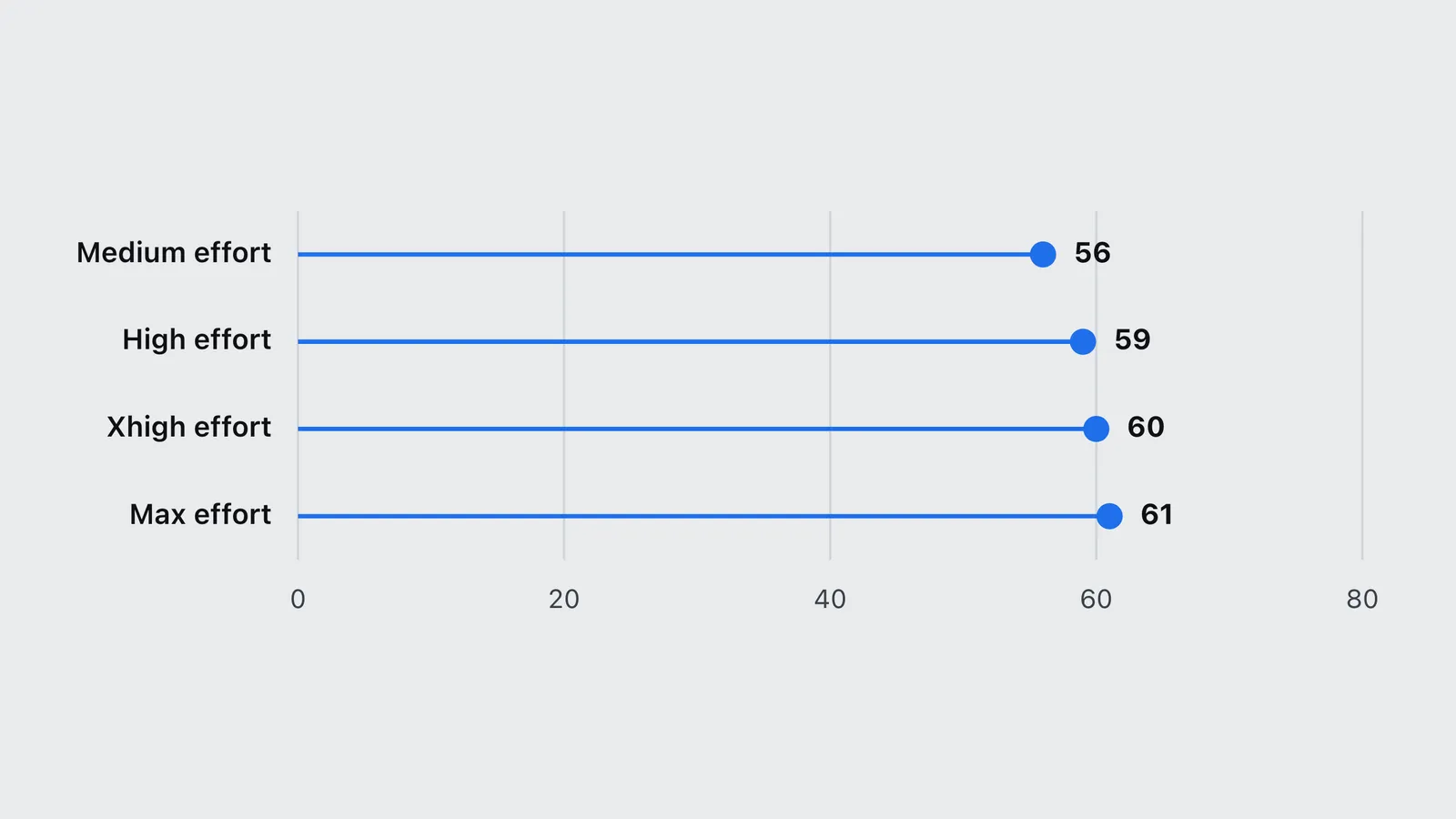
The payoff is visible on the independent Artificial Analysis Intelligence Index, a third-party composite of reasoning, knowledge, math, and coding tests. Opus 5 climbs from 56 at medium effort to 61 at max, a five-point spread on a hundred-point scale that you dial in or out by the task.
| Item | Value |
|---|---|
| Medium effort | 56 |
| High effort | 59 |
| Xhigh effort | 60 |
| Max effort | 61 |
The practical read: run low or medium effort for routine, well-scoped work, and reserve high or max for the hardest tasks where a few points of reliability pay for the extra tokens. It is the same intelligence-versus-cost trade the whole cost-per-task question turns on, now set with a parameter instead of a model swap.
Opus 5 versus Fable 5: frontier intelligence at half the price
Anthropic pitches Opus 5 as coming close to the frontier intelligence of Fable 5 at half the price. On the independent index, it does not merely come close: Opus 5 at max effort scores 61 against Fable 5 at 60 and GPT-5.6 Sol at 59, per Artificial Analysis. It does that at $25 per million output tokens against Fable 5 at $50.
| Item | Intelligence Index (max effort) | Output $ / Mtok |
|---|---|---|
| Claude Opus 5 | 61 | $25 |
| Claude Fable 5 | 60 | $50 |
| GPT-5.6 Sol | 59 | $30 |
Artificial Analysis reaches the same conclusion independently, framing the release as Fable 5 level intelligence at a lower cost per task. One caveat worth keeping: Opus 5 is verbose. Artificial Analysis measured it generating about 100 million tokens to complete the full index run against a 63-million median, so a lower per-token rate does not automatically mean a lower bill if the model talks more to get there. To cost a specific matchup on finished-job terms, the model comparison tool prices Opus 5 against Fable 5, Sonnet 5, and the rest on the same task.
What changed from Opus 4.8
The specs are a clean upgrade at the same price: a 1M-token context window, the effort dial, and the claude-opus-5 API id, available across Claude.ai, Claude Code, and the Claude API.
| Spec | Claude Opus 5 |
|---|---|
| Context window | 1M tokens |
| Effort settings | low, medium, high (xhigh, max on API) |
| API id | claude-opus-5 |
| Standard price | $5 / $25 per Mtok |
| Released | July 24, 2026 |
On the benchmarks Anthropic published with the launch, Opus 5 is a large step over Opus 4.8. Anthropic reports it setting a new state of the art on Frontier-Bench v0.1, CursorBench 3.2, ARC-AGI 3, and OSWorld 2.0, more than doubling Opus 4.8’s Frontier-Bench result and landing within 0.5% of Fable 5’s peak CursorBench score at half the cost per task. It stays behind the safety-hardened Mythos 5 on cybersecurity and biology tasks. What each of those tests actually measures, who built it, and where its official leaderboard lives is broken down in the AI benchmarks directory.
Does it change the cost per task?
At the sticker level, no. Because $5 / $25 is unchanged from Opus 4.8, a task that cost a given amount on Opus 4.8 costs the same on Opus 5 at the same effort and token count. The cost-per-task math carries over unchanged.
Two things do move the real bill, and they pull in opposite directions. The effort dial lets you spend less on routine work by running lower effort, which the old fixed-effort Opus line could not do. Against that, Opus 5’s verbosity and the thinking tokens that high effort spends can raise the token count on a given task even at the same rate. The number to budget on is dollars per finished task on your own workload, not the rate on the card, the same lens that applied to the Sonnet 5 pricing question and the three-way Opus, Fable 5, and GPT-5.6 comparison.
Should you switch?
This section was written when Opus 5 was the default on Claude Max and the strongest model on Claude Pro. Claude Opus 5.5 has held that slot since September 22, 2026, at $4 and $20, so rule 1 below now points one version further on. The reasoning still applies; the destination changed.
- Coming from Opus 4.8 or Opus 5, move to Opus 5.5 and set the effort dial. Lower price, higher scores, plus a lever to run cheaper on routine work. Pin an older version only for a frozen snapshot.
- Coming from Fable 5, test Opus 5 at max effort on your hardest task. If it clears your bar, you halve the token price for equal-or-better index performance.
- Watch verbosity, not just the rate. Measure output tokens per finished task before assuming the lower rate translates into a lower bill.
Opus 5 was the release that raised capability while holding the sticker flat and handed you a dial to spend less on the easy work. Its successor went further and cut the sticker too. The figure to watch is still cost per finished task on your own jobs, and the effort dial Opus 5 introduced is the parameter that tunes it.
Frequently asked questions
- How much does Claude Opus 5 cost?
- Standard API pricing is $5 per million input tokens and $25 per million output tokens, the same rate as Opus 4.8. Prompt-cache reads bill at $0.50 per million tokens. A premium Fast Mode runs at $10 / $50 for about 2.5 times the default output speed.
- Is Claude Opus 5 more expensive than Opus 4.8?
- No. Opus 5 cost exactly the same as Opus 4.8 at the standard rate, $5 input and $25 output per million tokens. The first Anthropic flagship to launch cheaper than its predecessor was Claude Opus 5.5 on September 22, 2026, at $4 and $20.
- What is the Claude Opus 5 effort dial?
- An effort setting with low, medium, and high levels in the product, plus xhigh and max on the API. Higher effort spends more thinking tokens for a higher score: on the Artificial Analysis Intelligence Index, Opus 5 rises from 56 at medium effort to 61 at max.
- How does Claude Opus 5 compare to Fable 5?
- At max effort, Opus 5 scores 61 on the independent Artificial Analysis Intelligence Index against Fable 5 at 60, while costing $25 per million output tokens versus Fable 5 at $50. It reaches near-frontier intelligence at roughly half the token price.
- What is the context window and API id of Claude Opus 5?
- Opus 5 has a 1M-token context window and the API id claude-opus-5. It is available on Claude.ai, Claude Code, and the Claude API, and is the default model on Claude Max.
Sources
- Anthropic. (2026). Introducing Claude Opus 5 [vendor launch post; release date, positioning, effort setting, launch benchmarks, Fast Mode]. Verified 2026-07-25. anthropic.com/news/claude-opus-5
- Anthropic. (2026). Pricing [Claude Platform docs; standard $5 / $25 rate, $0.50 cache read, $10 / $50 Fast Mode, batch and cache multipliers]. Verified 2026-07-25. platform.claude.com/docs/en/about-claude/pricing
- Artificial Analysis. (2026). Claude Opus 5: Intelligence, Performance and Price Analysis [independent; Intelligence Index by effort level, output-token volume, comparison with Fable 5 and GPT-5.6 Sol]. Verified 2026-07-25. artificialanalysis.ai/models/claude-opus-5
- Artificial Analysis. (2026). Opus 5: Fable 5 level intelligence at a lower cost per task [independent analysis article]. Verified 2026-07-25. artificialanalysis.ai/articles/opus-5