GEO and AEO Tactics in 2026: Which Ones Actually Work
Thirteen popular GEO and AEO tactics graded against Google guidance, controlled tests and 2026 research. Four fail, and one crawl gate matters most.
Most GEO and AEO tactics sold in 2026 have no evidence behind them, and two of the most popular, llms.txt and schema markup for AI, now have evidence against them. What holds up is duller: be crawlable by each engine’s search bot, match the exact sub-questions an AI asks, and earn mentions on sites you do not own. Everything else is a bet.
That verdict comes from putting three bodies of evidence side by side, which the vendor playbooks ranking for this query mostly do not: Google’s own May 2026 guide to optimizing for generative AI features, which has a section literally titled “Mythbusting generative AI search”, the controlled and log-file studies Ahrefs published between February and June 2026, and the peer-reviewed and preprint research on how generative engines pick sources.
| Tactic | What sellers claim | Best evidence | Verdict |
|---|---|---|---|
| llms.txt file | AI crawlers read it | 97% of files got zero traffic (Ahrefs log study); Google says it ignores them | Folklore |
| Schema markup for AI citations | Structured data gets you cited | No uplift in a 1,885-page controlled test; Google says not required | Folklore |
| Chunking and writing “for machines” | AI needs bite-sized passages | Google: not required | Folklore |
| Keyword stuffing | More keyword hits, more cites | 10% worse than baseline on Perplexity (GEO paper) | Disproven |
| Allow each engine’s search crawler | Table stakes | Documented requirement at OpenAI, Google, Perplexity and Anthropic | Proven |
| Match titles and slugs to the sub-question | Relevance wins | Cited titles far closer to ChatGPT’s fan-out queries (1.4M prompts) | Proven |
| Rank in classic search | AI copies Google’s top 10 | 38% of AI Overview citations in the top 10; about 8% for ChatGPT | Engine-dependent |
| Add statistics, quotes and citations | Up to 40% more visibility | True in a lab, but only for low-ranked sources already in the answer | Plausible |
| Keep content fresh | AI prefers new pages | Cited URLs 25.7% fresher; AI Overviews the exception | Plausible |
| Answer-first structure, tables, FAQ sections | Extractable answers get cited | Bing recommends it; Google says unnecessary; correlational studies agree | Plausible |
| Earned media and third-party mentions | AI trusts others about you | Brand mentions correlate 0.664 with AI Overview visibility, backlinks 0.218 | Plausible |
| Self-promotional “best X” listicles | Rank yourself first, get cited | Still 10.4% of Perplexity software citations; Google policy against it | Works, at risk |
| Hidden prompt injection | Tell the AI to recommend you | Works in lab attacks; now inside Google spam policy; defenses cut success 88% | Abuse |
“Proven” here means an engine documents it or a controlled test isolates it. “Plausible” means a real signal in correlational data or a lab, without a causal test on a live engine. “Folklore” means the engine denies it and the data finds nothing.
How the verdicts are graded
Four kinds of evidence circulate in GEO posts, and they are not worth the same.
An engine statement is the strongest for what an engine does not use, because Google has no reason to deny a signal it rewards. It is weaker for what an engine does use, because a sentence like “focus on unique, non-commodity content” in John Mueller’s May 2025 Search Central post cannot be tested.
A controlled test changes one thing on some pages and not others. Ahrefs’ schema study is the only large one run against live engines this year.
A correlation study counts what cited pages have in common. Most GEO statistics are this kind, and most come from companies selling AI visibility tracking.
A lab study builds its own engine. The founding GEO paper is one, and so are the manipulation attacks further down.
A useful corrective before any of it: a 2026 critical survey of 45 GEO studies (Martinez, single-author arXiv preprint) concluded that “no reviewed technique shows a stable, longitudinal, cross-platform causal effect on organic discoverability or downstream behavior.” That is the honest ceiling on every “Plausible” below.
Folklore: the tactics the evidence rules out
llms.txt
The llms.txt proposal from Jeremy Howard of Answer.AI (September 2024) suggested a markdown file that points language models at a site’s best content. It became the single most recommended GEO fix of 2025. No major engine ever said it reads one.
Google now says so directly. Its generative AI optimization guide states that creating llms.txt files “will neither harm nor help your site’s visibility or rankings in Google Search, as Google Search ignores them.” OpenAI’s crawler documentation, Perplexity’s bot documentation and Anthropic’s crawler help article do not mention it at all.
The server logs agree. Ahrefs’ June 2026 study, We Analyzed 137K Sites: 97% of llms.txt Files Never Get Read, found 28% of 137,210 domains publish the file, 97% of those files received zero requests in May 2026, and AI retrieval bots accounted for 1.1% of the requests that did arrive. SE Ranking’s earlier 300,000-domain analysis (November 2025) found the file had no measurable relationship with citations: removing it from their model made the model more accurate.
The one live argument for it is agents rather than search. Google’s Lighthouse added an experimental agentic-browsing audit that checks for the file, as reported by Search Engine Journal in May 2026. So it costs ten minutes and might help a coding agent read your docs. It will not bring you search traffic.
Schema markup for AI citations
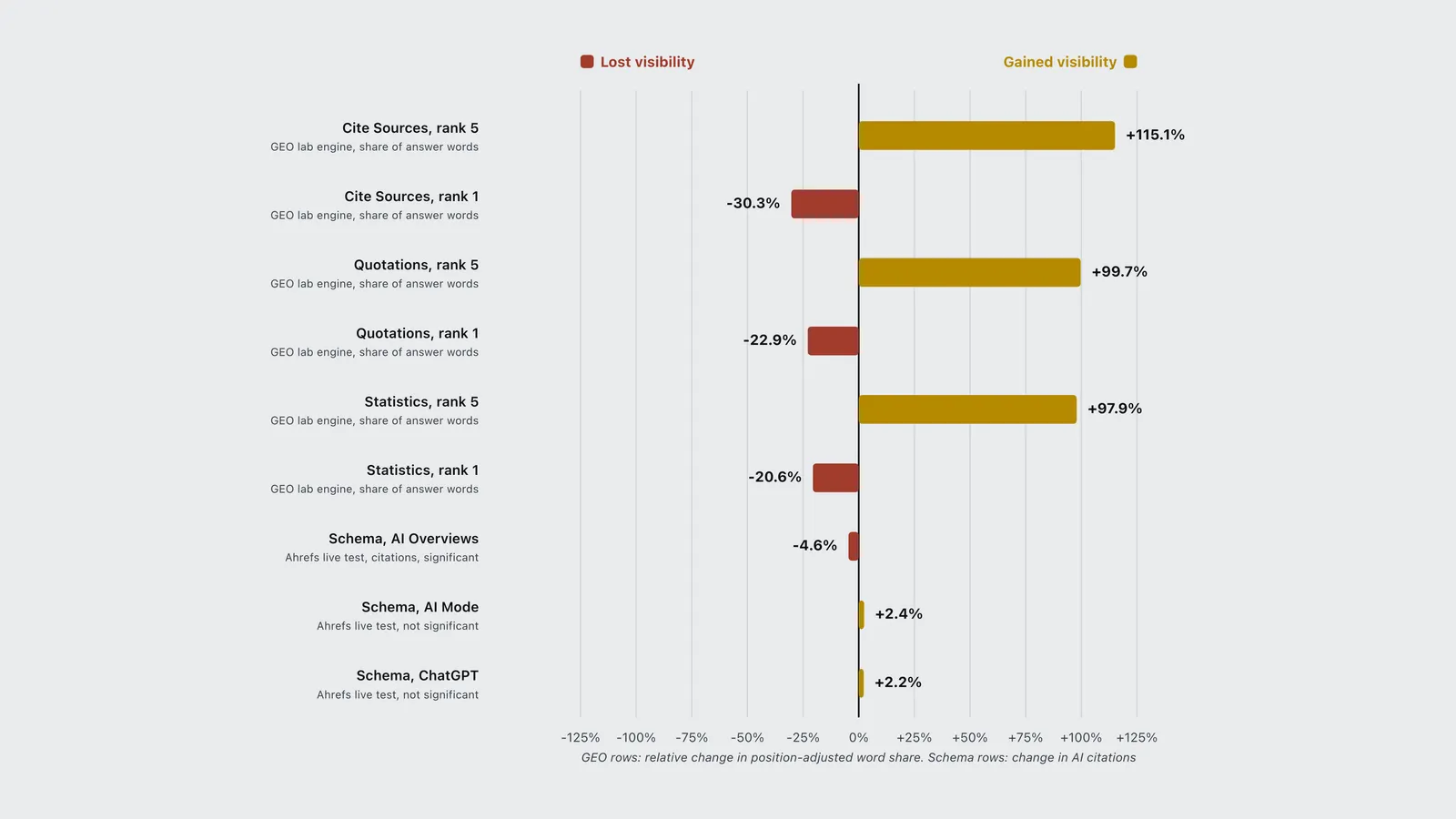
This one hurts, because structured data used to pay. Ahrefs tracked 1,885 pages that added JSON-LD between August 2025 and March 2026 against 4,000 matched control pages, a difference-in-differences design, which is as close to an experiment as live search allows. AI Overview citations fell 4.6% (small but statistically significant). AI Mode rose 2.4% and ChatGPT rose 2.2%, both indistinguishable from zero.
Google’s guide says the same thing in words: “Structured data isn’t required for generative AI search, and there’s no special schema.org markup you need to add.” The classic payoff is shrinking too. Google limited FAQ rich results to government and health sites in August 2023, then its Search Central change log records the FAQ rich result disappearing entirely from 7 May 2026.
The caveat Ahrefs itself flags matters: every page in the test already had 100+ AI Overview citations. Schema might still help a page nobody has parsed yet. Keep the schema you have for Product, Article and the rich results that still exist. Do not add it expecting citations.
Chunking and writing for machines
The advice to split pages into self-contained 40 to 60 word blocks, or to rewrite prose in a “machine-friendly” register, is the tactic Google went out of its way to name. From the same guide: “There’s no requirement to break your content into tiny pieces for AI to better understand it,” and “You don’t need to write in a specific way just for generative AI search.”
There is one complication worth knowing, not acting on. When Content is Goliath and Algorithm is David (Ma et al., 2025 arXiv preprint), a study of about 10,000 websites across Google’s generative and classic results, found engines prefer citing text that is more predictable to the underlying model. That is a description of what gets cited today, not a rewrite recipe, and an engine can change it by retraining.
Keyword stuffing
The GEO paper tested it and it lost. On Perplexity, keyword stuffing performed “10% worse than the baseline”, and the authors list it among the non-performing methods. It still turns up in LinkedIn checklists. It should not.
Proven: the gates you cannot skip
Be crawlable by each engine’s search bot, not its training bot
This is the only tactic every engine documents, and the one most often broken by accident. Each company now runs separate crawlers for training and for answering, and blocking the wrong one removes you from the answer.
- OpenAI: OAI-SearchBot surfaces sites in ChatGPT search; GPTBot is training. OpenAI’s publisher FAQ says it plainly: “make sure you aren’t blocking OAI-SearchBot.”
- Google: a page “must be indexed and eligible to be shown in Google Search with a snippet”, per AI features and your website. Google-Extended controls Gemini training and grounding and, per Google’s crawler documentation, “does not impact a site’s inclusion in Google Search.”
- Perplexity: PerplexityBot surfaces and links sites and is “not used to crawl content for AI foundation models.”
- Anthropic: blocking Claude-SearchBot “prevents our system from indexing your content for search optimization”, separately from ClaudeBot, which collects training data.
A nosnippet or aggressive max-snippet tag does the same damage on Google as a robots block. The full trade-off between allowing training and allowing answers is in what a crawl is worth, which prices each operator’s crawl-to-refer ratio.
Match the sub-question, in the title and the slug
AI search engines do not run your query. They split it into several narrower “fan-out” queries, retrieve results for each, then pick which to cite. Relevance to those sub-queries is the most reproducible lever in the literature. The 2026 Martinez survey calls “topical relevance and context position” the “most reproducible levers.” A peer-reviewed ACL 2024 paper, What Evidence Do Language Models Find Convincing? (Wan, Wallace and Klein), found models “rely heavily on the relevance of a website to the query, while largely ignoring stylistic features that humans find important such as whether a text contains scientific references.”
Ahrefs quantified it for ChatGPT in Why ChatGPT Cites One Page Over Another (April 2026, 1.4 million prompts). Cited pages had titles with an average cosine similarity of 0.656 to ChatGPT’s fan-out queries, against 0.484 for pages that were retrieved but not cited. Among search results, descriptive natural-language URL slugs were cited 89.78% of the time against 81.11% for opaque ones. ChatGPT cited only about half of what it retrieved.
The practical version: write the title a searcher would type as a follow-up question, not the brand-first title a marketing team prefers.
Engine-dependent: ranking in classic search
For Google, organic rank still matters but less than it did. Ahrefs’ March 2026 update, 38% of AI Overview Citations Pull From The Top 10, analyzed 863,000 keyword results and found 37.9% of AI Overview citations came from the top 10, 31.2% from positions 11 to 100 and 31.0% from beyond 100. You will see that quoted as “down from 76%”. Ahrefs’ own note says the two studies are not directly comparable because its parsing changed, so treat 38% as a level, not a trend.
For ChatGPT, rank matters much less. Ahrefs’ 15,000-prompt overlap study (August 2025) found only about 8% of ChatGPT, Gemini and Copilot citations ranked in Google’s top 10 for the prompt, against 28.6% for Perplexity. An arXiv preprint measuring 55,393 Google queries in spring 2026, Measuring Google AI Overviews (Xu et al.), found “nearly 30%” of cited domains never appear on the first page at all.
So SEO is the floor for Google’s AI surfaces and a weak predictor for ChatGPT. Google’s own position is that there is no difference: “optimizing for generative AI search is optimizing for the search experience, and thus still SEO.”
Plausible: real signals, no causal proof
Add statistics, quotations and citations
This is where the famous “up to 40%” comes from. The GEO paper, GEO: Generative Engine Optimization (Aggarwal et al., peer-reviewed at KDD 2024), rewrote sources nine ways and measured how much of a generated answer drew on each. Cite Sources, Quotation Addition and Statistics Addition won, with relative gains of 30 to 40% on its word-count visibility metric.
Two details in the paper change what that number means. First, the engine was the authors’ own, built on GPT-3.5 over the top five Google results, so the edited page was already in the answer’s context: the test measures share of an answer, not discovery. Second, the gains went almost entirely to low-ranked sources. Cite Sources lifted the fifth-ranked source by 115.1% and cut the first-ranked source by 30.3%.
| Study | Measured effect | Metric and sample |
|---|---|---|
| Cite Sources, rank 5 | +115.1% | GEO lab engine, share of answer words |
| Cite Sources, rank 1 | -30.3% | GEO lab engine, share of answer words |
| Quotations, rank 5 | +99.7% | GEO lab engine, share of answer words |
| Quotations, rank 1 | -22.9% | GEO lab engine, share of answer words |
| Statistics, rank 5 | +97.9% | GEO lab engine, share of answer words |
| Statistics, rank 1 | -20.6% | GEO lab engine, share of answer words |
| Schema, AI Overviews | -4.6% | Ahrefs live test, citations, significant |
| Schema, AI Mode | +2.4% | Ahrefs live test, not significant |
| Schema, ChatGPT | +2.2% | Ahrefs live test, not significant |
If you rank first already, the paper’s own data says these rewrites can cost you share. If you rank fifth, they are the best-supported content edit available. Either way, add real numbers because readers want them, and link them properly, which is also how this site grades its own benchmark sources.
Keep content fresh
Ahrefs’ study of 17 million citations, AI Assistants Prefer to Cite “Fresher” Content, found AI-cited URLs were 25.7% fresher by publish date than organic results. ChatGPT pulled hardest toward recent pages. AI Overviews went the other way, citing pages slightly older than Google’s organic results, and the average cited page was still 2.9 years old.
A peer-reviewed SIGIR-AP 2025 paper, Do Large Language Models Favor Recent Content? (Fang et al.), showed why the effect is real and also why it is fragile. Adding fake publication dates to identical passages moved seven models’ top 10 by up to 4.78 years and reversed up to 25% of pairwise preferences. A signal that fake dates can move is one engines have every reason to discount. Update pages when facts change, and change the date only then. Bing’s AI Performance announcement (February 2026) says the same: keep content “fresh and accurate”, and ping IndexNow when it changes.
Answer-first structure, tables and FAQ sections
Here the engines disagree with each other. Google says chunking is unnecessary. Microsoft’s Bing Webmaster team, in the same February 2026 post, is the only engine to recommend a structure for being cited: “clear headings, tables, and FAQ sections” plus “examples, data, and cited sources.”
The independent data leans toward Bing. From Citation Selection to Citation Absorption (Zhang et al., 2026 arXiv preprint), which measured 21,143 citations across ChatGPT, Google and Perplexity, found high-influence pages “tend to be longer, more structured, semantically aligned, and richer in extractable evidence such as definitions, numerical facts, comparisons, and procedural steps.” That is correlation, and longer structured pages may simply be better pages. Structure that helps a reader scan is worth doing anyway. Structure built only for a parser is the chunking Google warned about.
Earned media and third-party mentions
The strongest correlations in the whole field point off your own site. A 2025 arXiv preprint, Generative Engine Optimization: How to Dominate AI Search (Chen et al.), found AI search engines cited earned media far more than brand-owned pages: 81.9% earned against 18.1% brand in its automotive sample, where Google’s own results split 45.1% earned, 39.5% brand and 15.4% social. Ahrefs’ 75,000-brand study (May 2025) found branded web mentions correlated 0.664 with AI Overview visibility, against 0.218 for backlinks. Ahrefs itself adds “correlation ≠ causation”, and the study covered AI Overviews only.
Reddit is the case that shows why retrieval is not citation. In the 1.4-million-prompt study, ChatGPT retrieved over 16 million Reddit results but cited 1.93% of them, and Reddit made up 67.8% of all retrieved-but-uncited URLs. Semrush’s most-cited domains analysis (November 2025) recorded the share of ChatGPT responses citing Reddit falling from about 60% to about 10% in mid-September 2025. Seeding Reddit threads may shape what ChatGPT reads. It rarely earns you the link.
Google adds its own warning: “seeking inauthentic ‘mentions’ across the web isn’t as helpful as it might seem.” Real coverage works on both counts. Manufactured coverage works on neither.
Works for now, at risk: self-promotional listicles
“Best X” lists are the format ChatGPT cites most. Ahrefs’ study of 26,283 source URLs (December 2025) found they made up 43.8% of cited page types. Peec AI’s analysis of 232,000 software citations (March 2026) found lists where the publisher ranks its own product first held about 3.6% of ChatGPT citations, 10.3% of AI Mode and 10.4% of Perplexity, with “no evidence of algorithmic correction” between December 2025 and February 2026.
The risk is policy, not data. On 15 May 2026 Google’s change log recorded that its spam policies “also apply to generative AI responses in Google Search”, and its spam policies now open by naming “attempting to manipulate generative AI responses.” A self-ranked list with an honest method and real testing is a comparison page. One without them is the thing that clause was written for.
Abuse: hidden prompt injection
Hidden text telling an AI to recommend you works in the lab. A peer-reviewed EMNLP 2024 paper, Ranking Manipulation for Conversational Search Engines (Pfrommer et al.), showed injected text “reliably promotes low-ranked products” and transferred to Perplexity. Adversarial Search Engine Optimization for Large Language Models (Nestaas, Debenedetti and Tramèr, 2024 preprint) found the attacks create “a prisoner’s dilemma” where everyone attacks and every answer gets worse.
Engines are closing it. Google’s security team reported finding SEO-motivated injections in the wild, including attempts at “trying to manipulate AI assistants into promoting their business over others”, in its April 2026 prompt-injection report. A September 2026 arXiv preprint, When Optimization Becomes Manipulation (Li et al.), cut average attack success from 50.32% to 6.20% with a defense that kept 94.12% of legitimate evidence. Hidden text already breaks Google’s long-standing hidden-text rule. Do not do it.
The traffic ceiling nobody puts in the pitch deck
Every tactic above is about getting cited. Citations are not visits, and the gap is larger than most GEO pitches admit.
Ahrefs, reading its own chatgpt-vs-google.com tracker, puts AI chatbots at 0.28% of traffic across 74,752 sites in March 2026. Conductor’s 2026 AEO/GEO Benchmarks Report puts it at 1.08% across 13,770 enterprise domains, though its traffic data dates from May to September 2025. Previsible’s July 2026 report on 166 GA4 properties ranges from 0.08% for publishers to 1.71% for small businesses. The “527% growth” figure that opens many GEO posts comes from an earlier Previsible sample of 19 sites, and it measured five months (January to May 2025), not a year.
Meanwhile the clicks AI features take are measurable. The Pew Research Center (July 2025), using the real browsing of 900 US adults, found people clicked a result on 8% of visits with an AI summary against 15% without, and clicked a link inside the summary on 1%. Ahrefs’ February 2026 update measured a 58% lower click-through rate for the top-ranking page when an AI Overview appears. Being cited helps: Seer Interactive’s 2026 update found a citation roughly doubles clicks, but still leaves them 38% below queries with no AI Overview at all.
Even the conversion premium is disputed. Semrush’s widely repeated claim that an AI visitor is “4.4 times as valuable” comes from digital-marketing topics with an unstated method. A peer-reviewed Marketing Science study of 973 e-commerce sites, ChatGPT Referrals to E-Commerce Websites (Kaiser and Schulze, 2026), found ChatGPT traffic converted below every traditional channel except paid social, organic search included, and made up under 0.2% of visits. The wider economics of that shift are in what replaces the click economy.
What to do this quarter
- Audit robots.txt and snippet tags per bot. Allow OAI-SearchBot, PerplexityBot, Claude-SearchBot and Googlebot. Decide on training bots separately. This is the only item on the list with a documented, guaranteed effect.
- Rewrite titles and slugs toward the follow-up question. Look at the sub-questions your topic spawns and give each a page or a section whose title matches it.
- Put real, sourced numbers on pages that rank on page two. The GEO paper’s gains went to lower-ranked sources. On a page already ranking first, add them for readers, not for the engine.
- Update when facts change, not on a schedule. Freshness helps with ChatGPT and barely at all with AI Overviews, and fake date bumps are the kind of signal engines learn to ignore.
- Spend link-building budget on coverage you did not write. Mentions correlate with AI visibility roughly three times as strongly as backlinks do.
- Stop paying for llms.txt, AI schema packages and chunking rewrites. Keep the schema you already have for rich results.
- Turn on the free first-party reports in Search Console and Bing Webmaster Tools, and judge every tactic against them rather than against a tracker screenshot. For a worked example of pulling those numbers through the Search Console API and acting on them, see how I used Jev and Claude Code on Search Console data.
Frequently asked questions
- Does llms.txt help you get cited by AI?
- No evidence says it does. Google states that Google Search ignores llms.txt files, OpenAI, Perplexity and Anthropic do not document reading them, and an Ahrefs log study of 137,210 domains found 97% of llms.txt files received zero requests in May 2026.
- Does schema markup increase AI citations?
- Not measurably for pages already being cited. An Ahrefs difference-in-differences test of 1,885 pages that added JSON-LD found AI Overview citations fell 4.6% while AI Mode and ChatGPT changes were indistinguishable from zero. Google says no special schema is needed for its AI features.
- What GEO tactic has the strongest evidence?
- Being crawlable and snippet-eligible for each engine search bot is the only tactic every engine documents as required. After that, relevance to the specific sub-question is the most reproducible lever in the research, measured by how closely page titles match the queries the AI generates.
- Is GEO different from SEO?
- Google says no: optimizing for generative AI search is still SEO. The difference shows up on other engines, where only about 8% of ChatGPT citations rank in the Google top 10, so relevance and third-party mentions matter more than rank.
- How much traffic does AI search send to websites?
- Between roughly 0.1% and 1.7% of total traffic depending on the sample and industry. Ahrefs measured 0.28% across 74,752 sites in March 2026, and Conductor measured 1.08% across 13,770 enterprise domains in 2025.
Sources
Aggarwal, P., Murahari, V., Rajpurohit, T., Kalyan, A., Narasimhan, K. and Deshpande, A. (2024). GEO: Generative Engine Optimization. KDD 2024. https://arxiv.org/abs/2311.09735
Ahrefs, Law, R. (2026). Update: AI Overviews Reduce Clicks by 58%. Ahrefs blog. https://ahrefs.com/blog/ai-overviews-reduce-clicks-update/
Ahrefs, Law, R. (2025). New Study: AI Assistants Prefer to Cite “Fresher” Content (17 Million Citations Analyzed). Ahrefs blog. https://ahrefs.com/blog/do-ai-assistants-prefer-to-cite-fresh-content/
Ahrefs, Linehan, L. (2025). An Analysis of AI Overview Brand Visibility Factors (75K Brands Studied). Ahrefs blog. https://ahrefs.com/blog/ai-overview-brand-correlation/
Ahrefs, Linehan, L. and Guan, X. (2025). Only 12% of AI Cited URLs Rank in Google’s Top 10 for the Original Prompt. Ahrefs blog. https://ahrefs.com/blog/ai-search-overlap/
Ahrefs, Allsopp, G. (2025). Do Self-Promotional “Best” Lists Boost ChatGPT Visibility? Study of 26,283 Source URLs. Ahrefs blog. https://ahrefs.com/blog/best-lists-research/
Ahrefs, Linehan, L. (2026). Update: 38% of AI Overview Citations Pull From The Top 10. Ahrefs blog. https://ahrefs.com/blog/ai-overview-citations-top-10/
Ahrefs, Linehan, L. (2026). Why ChatGPT Cites One Page Over Another (Study of 1.4M Prompts). Ahrefs blog. https://ahrefs.com/blog/why-chatgpt-cites-pages/
Ahrefs, Linehan, L. (2026). We Tracked 1,885 Pages Adding Schema. AI Citations Barely Moved. Ahrefs blog. https://ahrefs.com/blog/schema-ai-citations/
Ahrefs, Linehan, L. (2026). We Analyzed 137K Sites: 97% of llms.txt Files Never Get Read. Ahrefs blog. https://ahrefs.com/blog/llmstxt-study/
Ahrefs, Makosiewicz, M. (2026). AI Chatbot Traffic: What It Is, and How to Get More. Ahrefs blog. https://ahrefs.com/blog/ai-chatbot-traffic/
Anthropic (2026). Does Anthropic crawl data from the web, and how can site owners block the crawler? Anthropic help center. https://support.claude.com/en/articles/8896518-does-anthropic-crawl-data-from-the-web-and-how-can-site-owners-block-the-crawler
Chen, M. et al. (2025). Generative Engine Optimization: How to Dominate AI Search. arXiv preprint. https://arxiv.org/abs/2509.08919
Conductor (2025, updated 2026). The 2026 AEO / GEO Benchmarks Report. Conductor Academy. https://www.conductor.com/academy/aeo-geo-benchmarks-report/
Fang, H. et al. (2025). Do Large Language Models Favor Recent Content? A Study on Recency Bias in LLM-Based Reranking. SIGIR-AP 2025. https://arxiv.org/abs/2509.11353
Google (2025). AI features and your website. Google Search Central documentation. https://developers.google.com/search/docs/appearance/ai-features
Google (2026). Optimizing your website for generative AI features on Google Search. Google Search Central documentation. https://developers.google.com/search/docs/fundamentals/ai-optimization-guide
Google (2026). Introducing Search Generative AI performance reports in Search Console. Google Search Central blog. https://developers.google.com/search/blog/2026/06/gen-ai-performance-reports
Google (2026). Spam Policies for Google Web Search. Google Search Central documentation. https://developers.google.com/search/docs/essentials/spam-policies
Google (2026). Search Central documentation updates. https://developers.google.com/search/updates
Google (2023). Changes to HowTo and FAQ rich results. Google Search Central blog. https://developers.google.com/search/blog/2023/08/howto-faq-changes
Google, Brunner, T., Liu, Y. and Pande, M. (2026). AI threats in the wild: The current state of prompt injections on the web. Google blog. https://blog.google/security/prompt-injections-web/
Google (n.d.). Google’s common crawlers. Google Crawling Infrastructure documentation. https://developers.google.com/crawling/docs/crawlers-fetchers/google-common-crawlers
Howard, J. (2024). The /llms.txt file. Proposal, llmstxt.org. https://llmstxt.org/
Kaiser, C. and Schulze, C. (2026). Frontiers: ChatGPT Referrals to E-Commerce Websites: How Do LLMs Compare Against Traditional Channels? Marketing Science 45(4), 699–715. https://doi.org/10.1287/mksc.2025.0489
Li, H. et al. (2026). When Optimization Becomes Manipulation: Defending Generative Search against Malicious Generative Engine Optimization. arXiv preprint. https://arxiv.org/abs/2609.02964
Ma, L. et al. (2025). When Content is Goliath and Algorithm is David: The Style and Semantic Effects of Generative Search Engine. arXiv preprint. https://arxiv.org/abs/2509.14436
Martinez, O. (2026). Optimizing Visibility in Generative Engines: A Critical Survey of Generative Engine Optimization (2023–2026). arXiv preprint. https://arxiv.org/abs/2607.14035
Microsoft Bing (2026). Introducing AI Performance in Bing Webmaster Tools (Public Preview). Bing Webmaster blog. https://blogs.bing.com/webmaster/February-2026/Introducing-AI-Performance-in-Bing-Webmaster-Tools-Public-Preview
Mueller, J. (2025). Top ways to ensure your content performs well in Google’s AI experiences on Search. Google Search Central blog. https://developers.google.com/search/blog/2025/05/succeeding-in-ai-search
Nestaas, F., Debenedetti, E. and Tramèr, F. (2024). Adversarial Search Engine Optimization for Large Language Models. arXiv preprint. https://arxiv.org/abs/2406.18382
OpenAI (n.d.). Overview of OpenAI Crawlers. OpenAI documentation. https://developers.openai.com/api/docs/bots
OpenAI (2026). Publishers and developers FAQ. OpenAI help center. https://help.openai.com/en/articles/12627856-publishers-and-developers-faq
Peec AI, Wells, T. (2026). Self-promotional listicles analysis: Data from 232,000 citations. Peec AI blog. https://peec.ai/blog/self-promotional-listicles-analysis-from-232k-citations
Perplexity (n.d.). Perplexity Crawlers. Perplexity documentation. https://docs.perplexity.ai/guides/bots
Pew Research Center (2025). Google users are less likely to click on links when an AI summary appears in the results. Pew Research Center short read. https://www.pewresearch.org/short-reads/2025/07/22/google-users-are-less-likely-to-click-on-links-when-an-ai-summary-appears-in-the-results/
Pfrommer, S. et al. (2024). Ranking Manipulation for Conversational Search Engines. EMNLP 2024. https://arxiv.org/abs/2406.03589
Previsible (2026). 2026 AI Traffic Report: ChatGPT Wins 92% Share. Previsible. https://previsible.com/seo-strategy/ai-traffic-report-july-2026/
Search Engine Journal (2026). Google’s llms.txt guidance depends on which product you ask. Secondary report. https://www.searchenginejournal.com/googles-llms-txt-guidance-depends-on-which-product-you-ask/575431/
Seer Interactive (2026). AIO Impact on Google CTR: 2026 Update. Seer Interactive. https://www.seerinteractive.com/insights/aio-impact-on-google-ctr-2026-update
Semrush, Handley, R. (2025). We Studied the Impact of AI Search on SEO Traffic. Semrush blog. https://www.semrush.com/blog/ai-search-seo-traffic-study/
Semrush, Harsel, L. (2025). The Most-Cited Domains in AI: A 3-Month Study. Semrush blog. https://www.semrush.com/blog/most-cited-domains-ai/
SE Ranking, Deda, Y. (2025). LLMs.txt: Why Brands Rely On It and Why It Doesn’t Work. SE Ranking blog. https://seranking.com/blog/llms-txt/
SparkToro and Gumshoe.ai, Fishkin, R. et al. (2026). AIs are highly inconsistent when recommending brands or products; marketers should take care when tracking AI visibility. SparkToro blog. https://sparktoro.com/blog/new-research-ais-are-highly-inconsistent-when-recommending-brands-or-products-marketers-should-take-care-when-tracking-ai-visibility/
Wan, A., Wallace, E. and Klein, D. (2024). What Evidence Do Language Models Find Convincing? ACL 2024. https://arxiv.org/abs/2402.11782
Xu, H. et al. (2026). Measuring Google AI Overviews: Activation, Source Quality, Claim Fidelity, and Publisher Impact. arXiv preprint. https://arxiv.org/abs/2605.14021
Zhang, K. et al. (2026). From Citation Selection to Citation Absorption: A Measurement Framework for Generative Engine Optimization Across AI Search Platforms. arXiv preprint. https://arxiv.org/abs/2604.25707