GitHub Copilot Pricing 2026: What AI Credits Really Cost
GitHub Copilot switched to usage-based AI Credits on June 1, 2026. What the $10 Pro plan really costs once metering kicks in, and whether it is still worth it.
GitHub Copilot still costs $10 a month. As of June 1, 2026, that $10 is only the floor: the plan now buys a fixed monthly allowance of GitHub AI Credits, and once you spend it, usage bills by the token at a cent per credit on top. For three years Copilot had the simplest pricing in AI coding, a flat fee with the meter kept out of sight. That era is over.
What changed is what the fee buys, not the fee itself. For a developer who uses Copilot the classic way, as tab-completion in the editor, nothing changed: completions stay unlimited. For anyone leaning on chat, the CLI, or the coding agent, the bill is now a function of tokens, and that number swings by more than an order of magnitude depending on the task.
This breaks down exactly what changed, what each plan costs once you read the credit line instead of the sticker, what a real task burns in credits, and whether Copilot is still worth it. If you mean the price of GitHub itself rather than its AI add-on, see the separate GitHub Free, Pro, Team, and Enterprise pricing guide. For where Copilot sits among the rival agents, see the 2026 AI coding agent landscape and the full AI coding agents comparison; for how its plans stack up on price against Claude Code, Cursor, and the rest, start with the AI coding plan pricing comparison.
What changed on June 1, 2026
Under the old model, billing was request-based. Each model interaction cost one premium request unit, and a multiplier was applied depending on which model answered, as GitHub’s billing migration documentation describes. You counted requests, not tokens.
The new system replaces premium request units with GitHub AI Credits. One credit equals $0.01, so a $10 budget covers 1,000 credits, per the usage-based billing documentation. The cost of an interaction now depends on two things: the model used and the number of tokens it consumes, priced at the published API rate for that model. This is the same token math that drives every other agent harness, now made explicit on the invoice.
Two things are worth pinning down before the plan table makes sense.
First, what is metered. AI credits are consumed by Copilot Chat, the Copilot CLI, the cloud coding agent, Copilot Spaces, Spark, and any third-party coding agents you point at your Copilot subscription. Second, what is not. Code completions and next edit suggestions, the original Copilot feature set, are not billed in AI credits and remain unlimited on all paid plans. That single carve-out decides whether the change touches you at all.
One practical note: as of mid-June 2026, GitHub has temporarily paused new sign-ups for the paid individual plans while it manages capacity. Existing subscribers can still upgrade.
What Copilot costs in 2026
There are six tiers, with prices and credit allowances published on GitHub’s Copilot plans overview. The individual plans are where the new credit math is easiest to read.
| Plan | Price | Included AI credits | Worth (at $0.01/credit) |
|---|---|---|---|
| Free | $0 | 2,000 completions + limited chat/agent | n/a |
| Pro | $10/mo | 1,500 credits | $15 |
| Pro+ | $39/mo | 7,000 credits | $70 |
| Max | $100/mo | 20,000 credits | $200 |
| Business | $19/seat/mo | 1,900 credits/seat | $19 |
| Enterprise | $39/seat/mo | 3,900 credits/seat | $39 |
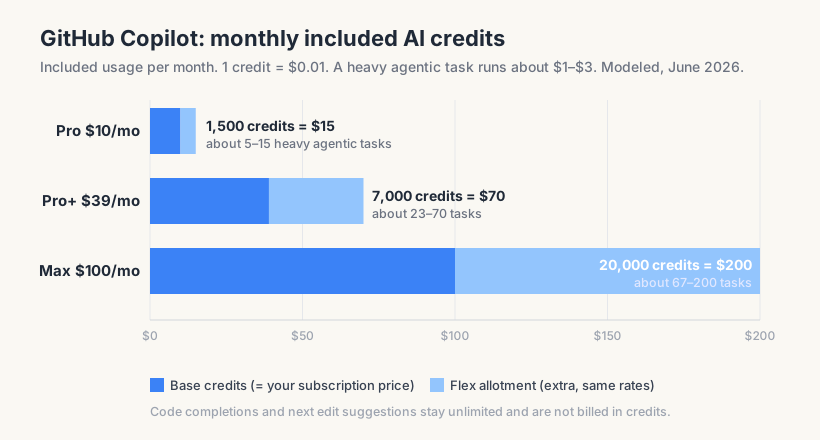
The first thing to notice is that the included usage is larger than the price. That is the flex allotment, introduced with the June change. Your base credits equal your subscription price one-to-one (Pro’s $10 buys 1,000 base credits) and stay fixed. On top of that sits a flex allotment that GitHub uses first only after the base is spent, billed at the same rates, and that it can adjust as the economics of AI shift. So Pro pairs $10 of base credits with $5 of flex for 1,500 total, Pro+ pairs $39 with $31 for 7,000, and the new Max plan pairs $100 with $100 for 20,000. The organization tiers carry their own per-seat pools (Copilot Business and Enterprise standard allotments are 1,900 and 3,900 credits per user, with larger promotional amounts of 3,000 and 7,000 running through September 1, 2026).
Two caveats matter when you budget. If you are on an annual Pro or Pro+ plan, you stayed on the old request-based billing after June 1, and when that annual term ends you are automatically downgraded to Copilot Free unless you pick a new plan. And once the included credits are gone, you either set a spending budget and keep working at $0.01 per credit or wait for the monthly reset. How the plans compare against the rest of the field sits in the AI coding plan pricing comparison.
The real cost is per task, not per month
Here is where the credit system is unexpectedly honest. By pricing every interaction in cents of tokens, Copilot has put a number on something most pricing pages hide: what a single task actually costs. The useful question is no longer “which plan,” it is “how many credits does my work burn.”
A 2026 preprint, How Do AI Agents Spend Your Money? (Bai et al.), with authors at the University of Michigan, Stanford University, All Hands AI, Google DeepMind, Microsoft AI and MIT, measured exactly that across SWE-bench Verified trajectories from eight frontier models. The headline findings: agentic coding tasks burn roughly 1000 times more tokens than ordinary code chat, input tokens drive the cost more than output, and runs on the same task can differ by up to 30x in total tokens. Higher spend does not buy higher accuracy, so the most expensive runs are often the failures. See which coding model burns the fewest tokens for the per-model breakdown. (It is a preprint, not yet peer-reviewed, so treat it as strong early evidence rather than settled fact.)
Convert that into credits. A multi-file agentic task that consumes a dollar or two of frontier-model tokens lands at 100 to 300 AI credits, because one credit is one cent. That is consistent with the Claude Code cost breakdown on this site, which modeled a comparable multi-file change at about $1.50 on a mid-tier model and $2.40 on a flagship: roughly 150 to 240 credits if the same work ran through Copilot’s meter.
Modeled cost per agentic task (illustrative, not a benchmark)
A multi-file change on a frontier model burns roughly $1 to $3 of tokens once you account for input, output, and the agent re-reading context on every turn. At 1 credit = $0.01, that is 100 to 300 AI credits per task.
A Pro plan’s 1,500 credits therefore covers about 5 to 15 such tasks a month before the meter starts. Pro+ covers roughly 23 to 70, Max roughly 67 to 200. These figures are modeled from published API rates and the token-consumption ranges in the Stanford and Microsoft preprint, in line with the editorial standards that govern numbers on this site. Your real numbers depend on your codebase and how tightly you scope the request.
That math explains the bills developers reported after June 1. Someone who treated the old flat plan as all-you-can-eat agent use, running the cloud agent and long CLI sessions all day, now hits the 1,500-credit ceiling in days, then pays a cent a credit for the rest of the month. The work did not get more expensive. It got visible, and for that one profile the visible number is large.
Where the new model wins
For most Copilot users, the honest answer is that nothing got worse, and some things got better.
If you mostly use Copilot as in-editor autocomplete, completions and next edit suggestions are unmetered, so $10 Pro buys the same unlimited inline assistance it always did. For that workflow Copilot remains one of the best-value tools a developer can buy, and the credit system never enters the picture. Light chat users are also fine: 1,500 credits absorbs a lot of one-off questions.
The genuinely new benefit is control. GitHub shipped user-level budgets for organizations and enterprises, so an admin can cap per-developer spend and get notified before it runs over. The flat plan never offered that. Predictable ceilings are worth something to anyone provisioning a team.
Where it burns money
The same meter that is invisible to a completion-first user punishes a few specific habits.
Running every task through the cloud agent or long CLI sessions on the cheapest plan is the main one: heavy agentic use on Pro exhausts 1,500 credits quickly, and the overage is uncapped unless you set a budget. Routing trivial work through the most expensive model is the second, and the preprint makes the case against it directly, since higher token spend does not translate into higher success. The third is the classic agent failure mode: letting a run loop unsupervised on a problem it cannot crack, paying credits for every re-read and re-edit that goes nowhere.
The fixes are boring and they work. Use unlimited completions for routine edits, reserve the metered agent for work that is genuinely hard, scope each agent task tightly, pick the cheapest model that can do the job, and set a spending budget so a runaway session cannot surprise you.
Is it worth it? It depends how you work
For a completion-first developer, Copilot at $10 is close to a rounding error against the time it saves, and the June change does not touch you. For a heavy agentic user, the calculation is now explicit: estimate your tasks per month, multiply by 100 to 300 credits, and compare the total to Pro’s 1,500, Pro+’s 7,000, or Max’s 20,000. If you are routinely past Pro+’s allowance, price Max against a competitor on the same workload before committing (for example Kiro’s credit plans, which sell credits at about two cents each), using the pricing comparison as the starting grid.
The people who should look hardest are the ones who were quietly subsidized under the flat plan: high-volume agent users who paid $10 for what now meters at many times that. For them the subscription floor is fine and the overage meter is the trap.
Frequently asked questions
Is GitHub Copilot still worth it in 2026?
For most developers, yes. If you use Copilot mainly for in-editor completions, the $10 Pro plan is unchanged: completions and next edit suggestions stay unlimited and are never billed in credits. The June 2026 switch to usage-based billing only affects heavy users of chat, the CLI, and the coding agent, who now pay for the tokens those features consume.
What are GitHub Copilot AI Credits?
GitHub AI Credits are the unit of usage-based billing introduced on June 1, 2026, replacing premium request units. One credit equals $0.01. Metered features (chat, CLI, cloud agent, Spaces, third-party agents) consume credits based on the model used and the tokens it processes. Code completions and next edit suggestions do not consume credits.
How much does GitHub Copilot cost per month?
The base prices are $10 for Pro, $39 for Pro+, and $100 for the new Max plan, plus $19 and $39 per seat for Business and Enterprise. Each tier includes a monthly credit allowance (1,500 credits on Pro, 7,000 on Pro+, 20,000 on Max). Heavy agentic users can exceed the allowance and pay $0.01 per additional credit, so real-world spend can run well above the sticker price.
Why did my Copilot bill suddenly go up?
Because billing moved from flat-rate requests to token-metered credits on June 1, 2026. If you ran the coding agent or long CLI sessions heavily, you were effectively subsidized under the old flat plan; the new meter prices that usage explicitly. A multi-file agentic task can burn 100 to 300 credits, so Pro’s 1,500-credit allowance covers only about 5 to 15 such tasks before overage.
Is Copilot cheaper than Claude Code?
It depends on workload shape. For unlimited in-editor completion, Copilot’s $10 Pro is hard to beat. For heavy multi-file agent work, both now bill by the token, so the comparison comes down to per-task token efficiency rather than sticker price. The Claude Code cost breakdown models the per-task math that makes a real comparison possible.
Bottom line
Budget Copilot by the task, not the sticker. The $10 line still buys unlimited completions, and for the developer who lives in autocomplete the June change is a non-event. The moment you lean on the agent, the relevant number is credits per task (call it 100 to 300 for real multi-file work) multiplied by how many tasks you run and how disciplined you are about model choice and scope. Copilot did not get more expensive in 2026. It got legible, which is good news for anyone who was paying attention to cost and an unwelcome surprise for anyone who was not.
Sources
- GitHub (2026). GitHub Copilot is moving to usage-based billing (company news). github.blog
- GitHub (2026). Updates to GitHub Copilot billing and plans (changelog, June 1, 2026). github.blog
- GitHub (2026). Introducing flex allotments in Pro and Pro+, and a new Max plan (company news). github.blog
- GitHub Docs (2026). Plans for GitHub Copilot (per-plan prices, including Business and Enterprise seat prices). docs.github.com
- GitHub Docs (2026). Usage-based billing for individuals (credit mechanics, metered vs unlimited features). docs.github.com
- GitHub Docs (2026). Usage-based billing for organizations and enterprises (Business and Enterprise allowances). docs.github.com
- GitHub Docs (2026). What changed with billing (premium request units, annual-plan transition). docs.github.com
- Bai, L., et al. (2026). How Do AI Agents Spend Your Money? Analyzing and Predicting Token Consumption in Agentic Coding Tasks. arXiv preprint arXiv:2604.22750. arxiv.org/abs/2604.22750