GPT-6 Sol and Luna: Pricing and Benchmarks
GPT-6 Sol and Luna halve OpenAI prices to $2/$10 and $0.10/$0.50. Sol lands on exactly the Claude Sonnet 5 rate card and outscores it at every effort level.
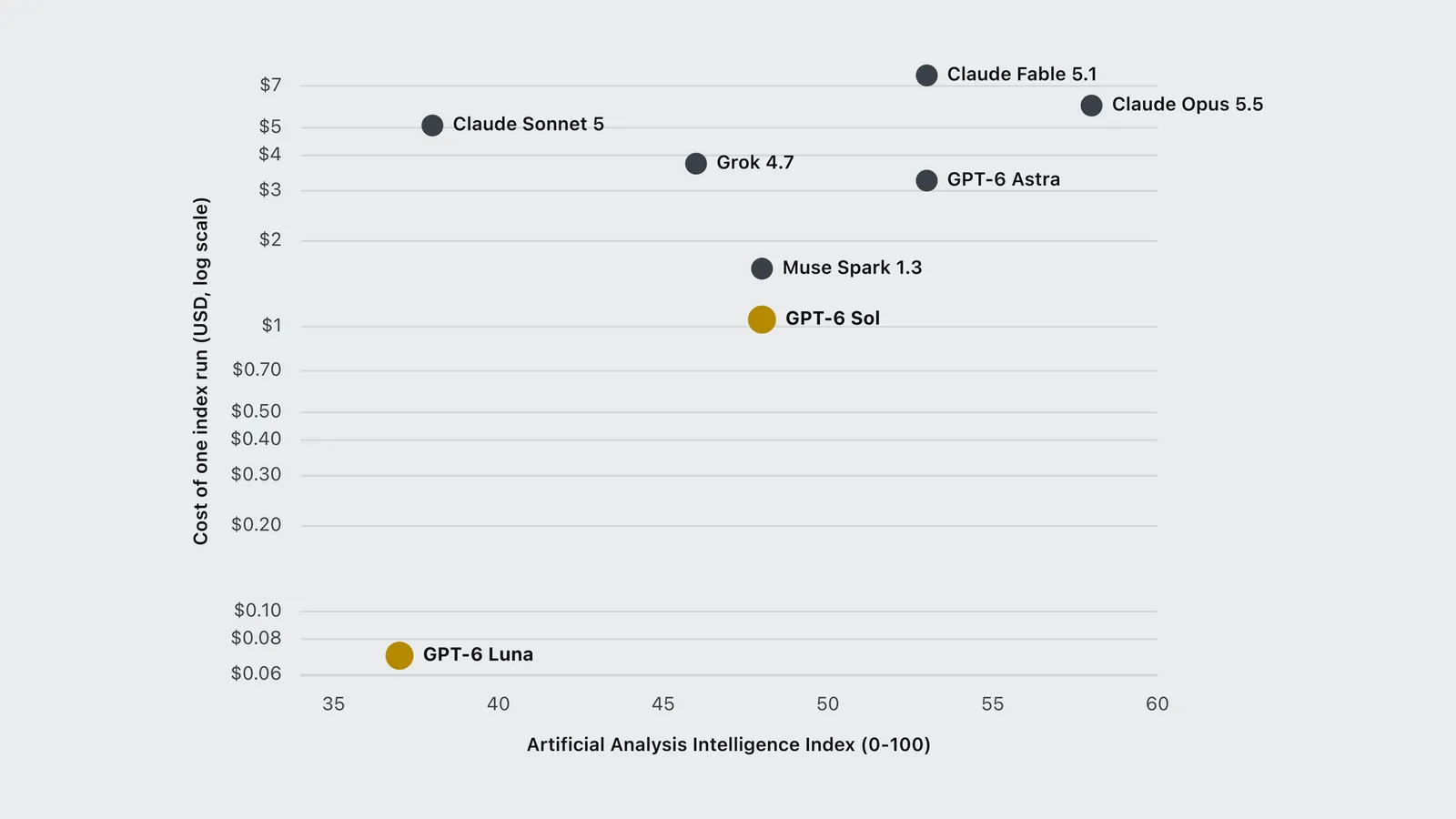
OpenAI released GPT-6 Sol and GPT-6 Luna on September 22, 2026. Sol lists $2 per million input tokens and $10 per million output, against the $4 and $20 the GPT-5.6 Sol it replaces charges. Luna lists $0.10 and $0.50 against $0.20 and $1.20. Both are roughly half, and Luna is slightly more than half.
The number that matters is not the size of the cut. It is where Sol landed. At $2 input, $10 output and a $0.20 cached read, GPT-6 Sol matches the Claude Sonnet 5 rate card on all three lines, to the cent. Artificial Analysis scores Sol 48 at max effort and Sonnet 5 at 38. A price that identical is a decision, not a coincidence.
| Item | Artificial Analysis Intelligence Index (0-100) | Cost of one index run (USD, log scale) |
|---|---|---|
| Claude Opus 5.5 | 58 | $6 |
| Claude Fable 5.1 | 53 | $8 |
| GPT-6 Astra | 53 | $3 |
| GPT-6 Sol | 48 | $1 |
| Claude Sonnet 5 | 38 | $5 |
| GPT-6 Luna | 37 | $0.07 |
| Grok 4.7 | 46 | $4 |
| Muse Spark 1.3 | 48 | $2 |
OpenAI’s claim is that “the GPT-6 models lead across the cost-intelligence curve.” On this chart that holds for the tiers it just cut and not for the one it did not: Astra at 53 for $3.26 is beaten by nothing at its score, but Claude Opus 5.5 reaches 58, which no GPT-6 model does at any price.
How much do GPT-6 Sol and Luna cost?
Every rate below is from OpenAI’s API pricing documentation, read September 23, 2026.
| Billing line | GPT-6 Sol | GPT-5.6 Sol | GPT-6 Luna | GPT-5.6 Luna |
|---|---|---|---|---|
| Input per Mtok | $2 | $4 | $0.10 | $0.20 |
| Output per Mtok | $10 | $20 | $0.50 | $1.20 |
| Cached input / Mtok | $0.20 | $0.40 | $0.01 | $0.02 |
| Batch input | $1 | $2 | $0.05 | $0.10 |
| Batch output | $5 | $10 | $0.25 | $0.60 |
Both carry a 1,050,000-token context window (922,000 max input, 128,000 max output) and six effort levels from none to max. Knowledge cutoffs differ: Sol is April 20, 2026 and Luna is May 18, 2026, so the cheaper model has the fresher training data. Prompts over 272,000 tokens bill the whole request at 2x input and cache and 1.5x output, the same structure GPT-6 Astra uses.
The Luna cut is bigger than OpenAI says it is. The announcement describes both models as “50% cheaper.” For Sol that is exact on every line. For Luna, input and cache halve but output falls from $1.20 to $0.50, which is 58.3%. On the blend Artificial Analysis uses, seven parts cached read to two parts fresh input to one part output, Luna goes from $0.174 to $0.077 per million tokens: a 55.7% reduction, not 50%. OpenAI understates its own cut on the tier where it cut hardest.
Sol on the same blend goes from $3.08 to $1.54, exactly half.
GPT-6 Sol costs exactly what Claude Sonnet 5 costs
This is the comparison worth acting on, because the price variable is removed. GPT-6 Sol and Claude Sonnet 5 charge $2 input, $10 output and $0.20 per cached read. Not similar: identical, line for line.
On the site’s modeled multi-file coding task, 1.35 million cached reads, 150,000 fresh input tokens and 40,000 output tokens, both come out at about $0.97. The same number, because the same rate card multiplied by the same token profile can only give the same answer. What differs is what you get for it.
| Metric | GPT-6 Sol | Claude Sonnet 5 |
|---|---|---|
| max effort | 48 | 38 |
| xhigh effort | 44 | 34 |
| high effort | 43 | 32 |
| medium effort | 40 | 28 |
| low effort | 34 | 24 |
Sol leads by 10 to 14 index points at every setting. The gap is widest at medium, which is both models’ default, where Sol scores 40 to Sonnet 5’s 28.
One thing the index does not capture: measured output speed. Artificial Analysis records GPT-6 Sol at 131 tokens per second at max effort against 79 for Claude Sonnet 5, so the faster model is also the higher-scoring one here.
Both labs published a comparison table that went stale the same day
GPT-6 Sol and Luna shipped on September 22. So did Claude Opus 5.5. Each lab benchmarked against a rival model the rival replaced that day.
OpenAI’s announcement compares Sol and Luna against Claude Opus 5 throughout, including its headline that Sol at xhigh effort beats Opus 5 at max on AutomationBench for 9% of the cost per task. Anthropic’s Opus 5.5 table compares against GPT-5.6 Sol, recording it at 28.8% on AutomationBench and 37.3% on Terminal-Bench 4.0. Neither table names the other lab’s new model.
This is not dishonesty. Launch benchmarking runs on a schedule set weeks in advance, and neither lab knew the other’s date. It is a reason to treat launch-day comparison tables as dated the moment they publish.
Credit where it is due on the other side: Anthropic’s footnotes reconcile its own Terminal-Bench setup against the public board, noting that the leaderboard reports Claude Opus 5 at 51.8% where its internal run reproduces 52.3%. OpenAI publishes no equivalent reconciliation for any figure in its announcement.
The DeepSWE number that needs its harness named
OpenAI reports GPT-6 Sol at 68.8% on DeepSWE v1.1. The independent DeepSWE board, updated September 22, 2026, records GPT-5.6 Sol at 73%, the model GPT-6 Sol replaces.
Read quickly, that says the new model is worse than the old one. Read properly, it says almost nothing, and the reason is stated on the board itself: every model there runs on the same mini-swe-agent harness, specifically so its rows compare to each other. OpenAI does not name the harness behind its 68.8%. Two numbers produced under unstated and probably different conditions cannot be subtracted.
This is the same trap covered in why AI benchmarks are unreliable, and the same one that made Grok 4.7 read as three different models depending on who ran it.
What the board does support is the top of its own table, where three configurations tie within overlapping confidence intervals:
| Model | DeepSWE v1.1 | Avg cost per task |
|---|---|---|
| GPT-6 Astra (xhigh) | 74% ±3 | $4.43 |
| Gemini 3.8 Flash (high) | 74% ±1 | $2.36 |
| Claude Opus 5 (max) | 74% ±4 | $11.84 |
| GPT-5.6 Sol (max) | 73% ±3 | $6.46 |
| GPT-5.6 Luna (max) | 67% ±4 | $0.61 |
| Claude Sonnet 5 (max) | 54% ±4 | $26.40 |
Three models reach the same score for $2.36, $4.43 and $11.84. Neither GPT-6 Sol, GPT-6 Luna nor Claude Opus 5.5 had been run as of September 23. The /ai-benchmarks/ entry for DeepSWE tracks the board rather than the vendor figures.
What Luna changes
GPT-6 Luna at $0.10 and $0.50 is the cheapest row this site tracks, and the gap to everything else is larger than the headline suggests.
Artificial Analysis runs its entire Intelligence Index on Luna at max effort for $0.07, and scores it 37. The same evaluation costs $5.98 on Claude Opus 5.5, which scores 58. That is 21 more index points for about 85 times the money. On the modeled multi-file task, Luna comes out near $0.05 against $1.67 on Opus 5.5, a 34x spread.
Luna is not a frontier model and nothing above argues it is. What it changes is the floor: classification, extraction, routing, summarization and evaluation work that was marginal at $0.20 and $1.20 is now half that again, and Luna’s 67% on the DeepSWE board at $0.61 per task says the tier is no longer trivially weak at real engineering work either.
Which one should you use?
- On GPT-5.6 Sol or Luna today: move. Both successors are cheaper on every line, score higher on the vendor’s own tables, and share the context window and effort controls. The older rows stay callable if something is pinned to them.
- Choosing between GPT-6 Sol and Claude Sonnet 5: the price is identical, so decide on the harness and on your own evaluations. The independent aggregate favors Sol at every effort level, and Sol is measurably faster. If your stack lives inside Claude Code, that is worth points no index measures.
- Choosing between GPT-6 Sol and GPT-6 Astra: Astra costs 5x Sol per token and scores 5 index points higher at max. On the cost-per-task model that gap is rarely worth it unless a task fails on Sol outright, which is exactly the argument GPT-6 Astra’s own pricing breakdown makes from the other direction.
- For volume work: Luna, and set the effort dial low. At $0.0045 per index run at low effort it is close to free at the scales where these decisions matter.
Current rates for every model tracked here, each dated and sourced, sit on the AI model tracker, and the cost calculator will model your own token profile.
Frequently asked questions
- How much do GPT-6 Sol and GPT-6 Luna cost?
- GPT-6 Sol costs $2 per million input tokens and $10 per million output, with cached input at $0.20. GPT-6 Luna costs $0.10 and $0.50, with cached input at $0.01. Batch pricing halves both. Prompts over 272,000 tokens bill the whole request at 2x input and 1.5x output.
- Are GPT-6 Sol and Luna really 50 percent cheaper?
- Sol is, exactly, on every line. Luna is cheaper than that. Its input and cached read halve, but output falls from $1.20 to $0.50, which is 58.3 percent. On the blend Artificial Analysis uses, Luna falls 55.7 percent rather than 50, so OpenAI understates its own cut on the cheaper tier.
- Is GPT-6 Sol better than Claude Sonnet 5?
- They cost exactly the same, $2 input, $10 output and $0.20 per cached read. On the independent Artificial Analysis Intelligence Index, GPT-6 Sol scores higher at every effort level: 48 against 38 at max, 40 against 28 at medium. Sol is also faster, at 131 output tokens per second against 79. Neither figure accounts for harness fit, so test on your own workload.
- Did GPT-6 Sol score lower than GPT-5.6 Sol on DeepSWE?
- The two numbers are not comparable. OpenAI reports GPT-6 Sol at 68.8 percent on DeepSWE v1.1 without naming its harness, while the independent DeepSWE board records GPT-5.6 Sol at 73 percent running on mini-swe-agent, the harness it standardizes on so its rows compare to each other. The board had not run GPT-6 Sol as of September 23, 2026.
- What happened to the GPT-5.6 Sol promotional rate expiring November 21, 2026?
- OpenAI settled it two months early by releasing a cheaper successor instead of letting the rate revert. GPT-6 Sol arrived on September 22, 2026 at $2 and $10, half the $4 and $20 promotional rate. GPT-5.6 Sol remains listed at $4 and $20 for workloads pinned to it.
- Which GPT-6 model is cheapest to run?
- GPT-6 Luna, by a wide margin. Artificial Analysis runs its full Intelligence Index on Luna at max effort for $0.07 and scores it 37, against $3.26 and a score of 53 on GPT-6 Astra. At low effort Luna runs the same evaluation for $0.0045.
Sources
OpenAI (2026). Introducing GPT-6 Sol and Luna. Provider announcement (release date, price table, vendor-reported benchmarks, availability). https://openai.com/index/introducing-gpt-6-sol-and-luna/ Verified 2026-09-23.
OpenAI (2026). API pricing. OpenAI developer documentation (input, output, cached input and batch rates for both models and their predecessors). https://developers.openai.com/api/docs/pricing Verified 2026-09-23.
OpenAI (2026). Model documentation: gpt-6-sol and gpt-6-luna. OpenAI developer documentation (context window, max input and output, knowledge cutoffs, effort levels, long-context surcharge). https://developers.openai.com/api/docs/models/gpt-6-sol Verified 2026-09-23.
Artificial Analysis (2026). LLM Leaderboard. Independent benchmarking service (Intelligence Index by effort level, cost per index run, output speed). https://artificialanalysis.ai/leaderboards/models Verified 2026-09-23.
Datacurve (2026). DeepSWE v1.1 leaderboard. Independent benchmark, all models run on the mini-swe-agent harness (pass@1, confidence intervals, average cost per task). https://deepswe.datacurve.ai/ Verified 2026-09-23.
Anthropic (2026). Claude Opus 5.5. Provider announcement, used only for the comparison-table and AutomationBench footnote claims. https://www.anthropic.com/claude-opus-5-5 Verified 2026-09-23.
The OpenAI announcement page returns HTTP 403 to a plain HTTP fetch, as it did at the GPT-6 Astra launch. It and both leaderboards were read in a headless browser on September 23, 2026.