Meta VR Glasses vs Quest 3: Compute and Price
Meta VR Glasses cost $1,299.99, about 2.2x a Quest 3. The chip, RAM and per-dollar math, and what the premium buys in weight and pixels.
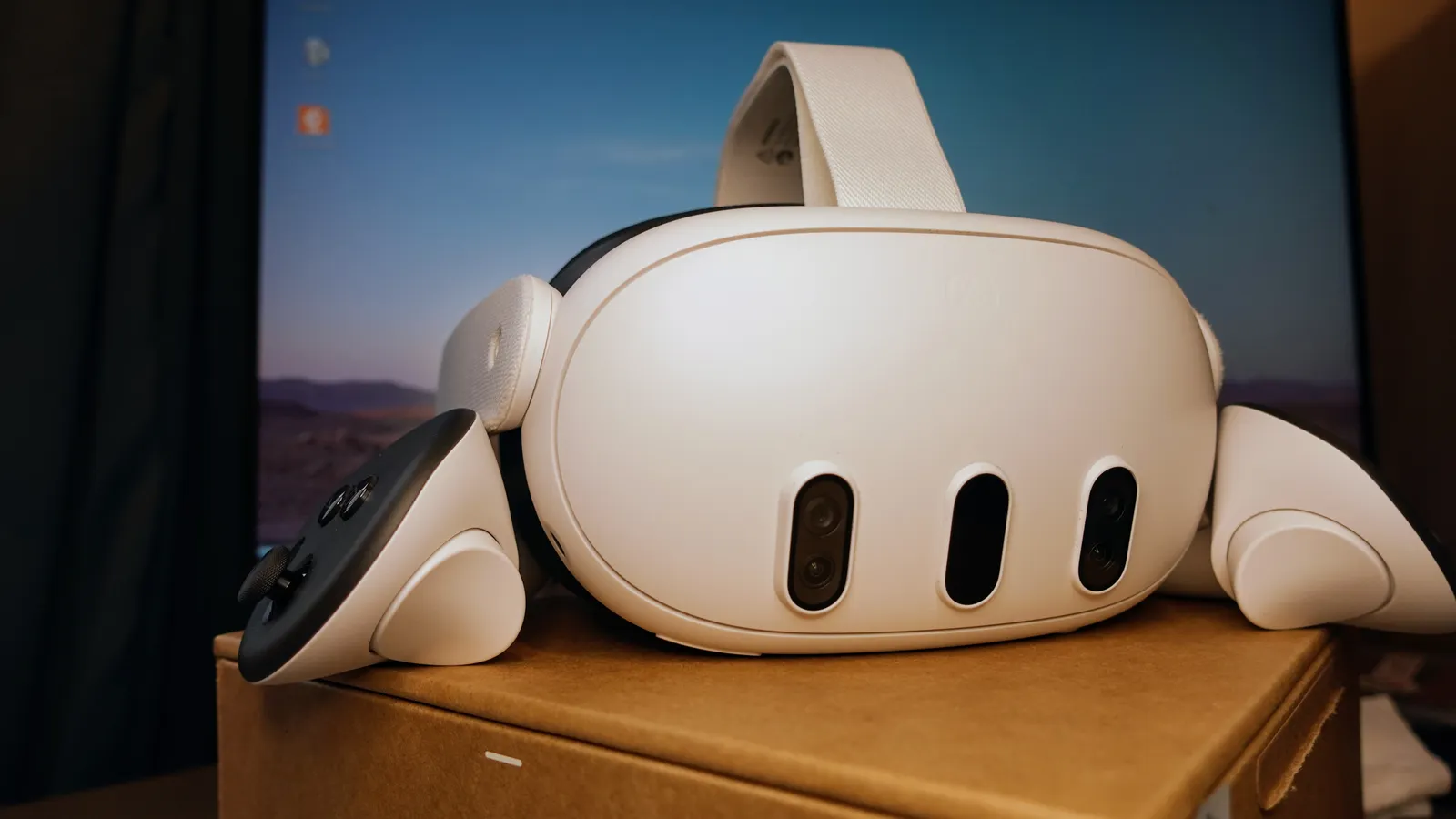
Meta VR Glasses cost $1,299.99 and Meta Quest 3 costs $599.99, so the new device is about 2.2 times the price. On compute per dollar, Quest 3 wins clearly. The VR Glasses run a newer Qualcomm chip, the Snapdragon Reality Elite, with 12GB of RAM against the Quest 3’s 8GB, but the reported GPU clock gain over Quest 3 is only about 11%. The extra $700 buys a visor that weighs about 100 grams instead of 515, and a sharper micro-OLED picture at 37 pixels per degree instead of 25. It does not buy proportionally more compute. Meta announced the VR Glasses on September 23 2026 for a spring 2027 ship date.
| Spec | Meta VR Glasses (2027) | Meta Quest 3 (2023) |
|---|---|---|
| US price | $1,299.99, controllers sold separately | $599.99 (512GB), controllers included |
| Chip | Snapdragon Reality Elite, in a pocket puck | Snapdragon XR2 Gen 2, in the headset |
| RAM | 12GB (reported) | 8GB LPDDR5 |
| Built-in storage | 128GB, plus microSD | 512GB |
| Display, per eye | 2,412 x 2,288 micro-OLED (5.5MP) | 2,064 x 2,208 LCD (4.6MP) |
| Sharpness | 37 pixels per degree | 25 pixels per degree |
| Field of view | 70° horizontal x 66° vertical | about 110° horizontal x 96° vertical |
| Weight on the face | about 100g (puck about 300g, carried) | 515g |
| Battery | up to 3 hours of media playback, in puck | in the headset |
| Ships | spring 2027 | on sale now |
What the Meta VR Glasses cost, and what Quest 3 costs now
Meta lists the VR Glasses at $1,299.99 in the US, in its launch announcement, with shipping set for spring 2027 and no exact date. Controllers are not in the box. Road to VR’s hands-on report confirms that the glasses work with the same Touch Plus controllers Quest 3 and Quest 3S owners already have, so a Quest owner can reuse a pair, while a new buyer adds the controllers on top of the list price.
Quest 3 is not at its launch price either. Meta raised the Quest 3 to $599.99 on April 19 2026, up $100, and lifted both Quest 3S tiers by $50 to $349.99 and $449.99. The company named the cause directly: “the global surge in the price of critical components, specifically memory chips.” The Quest 3 launched at $499 for 128GB and $649 for 512GB in 2023, per Meta’s 2023 launch announcement, and the 512GB unit is now the only Quest 3 on sale.
That gives a clean head-to-head today: $1,299.99 against $599.99, a $700 gap, or about 2.2 times the price.
Compute: Snapdragon Reality Elite vs XR2 Gen 2
The chip generation gap is real, but it is smaller than the headline percentages suggest, because Qualcomm measured against a different chip than the one in Quest 3.
Qualcomm launched the Snapdragon Reality Elite at the Augmented World Expo on June 16 2026. In UploadVR’s report of the announcement, Qualcomm claims up to 60% more GPU performance, 30% more CPU performance and 160% more NPU performance (48 TOPS) than the Snapdragon XR2+ Gen 2, plus support for faster RAM (4.2 GHz, up from 3.2 GHz) and UFS 4.0 storage. These are vendor claims, not independent benchmarks.
Quest 3 does not use the XR2+ Gen 2. It uses the base Snapdragon XR2 Gen 2, per Qualcomm’s device listing. When Qualcomm announced the plus variant in January 2024, it clocked the GPU 15% higher and the CPU 20% higher than the base chip with identical performance per watt, according to UploadVR’s coverage of that launch.
Stacking the two vendor claims gives the ceiling. This is a modeled upper bound, not a measurement:
- GPU ceiling: 1.60 x 1.15 = about 1.84x Quest 3, or up to 84% more.
- CPU ceiling: 1.30 x 1.20 = about 1.56x Quest 3, or up to 56% more.
The ceiling assumes the chip runs at Qualcomm’s maximum clocks. Meta’s configuration may not. The visor is fanless and passively cooled, per UploadVR, and the compute sits in a pocket puck with a battery rated for about three hours. Road to VR reports that the VR Glasses chip runs “up to 11% higher max GPU frequency” than Quest 3. The two figures measure different things, since a newer GPU can do more work per clock, but 11% more clock speed is the only figure specific to the shipping configuration so far. The realistic GPU gain probably sits between 11% and 84%, and nobody outside Meta can yet say where.
Foveated rendering is the real compute question
The bigger lever is not the chip. The VR Glasses have four-camera eye tracking. UploadVR reports that Quest content renders “at notably higher resolution thanks to a combination of the more powerful chipset” and eye-tracked foveated rendering, which shades full detail only where the eye is looking. Road to VR’s hands-on says eye tracking “appears to only be for UI stuff for now.” The two outlets disagree, and Meta’s own announcement does not mention foveated rendering.
This matters because the VR Glasses drive 5.5 million pixels per eye against 4.6 million on Quest 3, 21% more, at up to 120Hz. With working foveated rendering, a modest GPU gain covers that easily. Without it, most of the extra GPU headroom goes to filling the extra pixels, and the per-frame work available to a game rises far less than the chip generation implies. Until Meta confirms foveated rendering at launch, treat higher rendered resolution as likely but unconfirmed.
RAM: 12GB during a memory shortage
The VR Glasses carry 12GB of RAM, per UploadVR’s spec sheet, against 8GB of LPDDR5 in Quest 3. That is 50% more memory, launched in the most expensive memory market in years. For the market backdrop, see why RAM is so expensive and the live memory price tracker.
Price per unit: what $1,299.99 buys against $599.99
Dividing each price by what the hardware delivers shows where the premium goes. All figures below are arithmetic on the list prices and published specs above.
| Measure | Meta VR Glasses | Meta Quest 3 | Better value |
|---|---|---|---|
| Price per GB of RAM | $108 | $75 | Quest 3 |
| Price per pixel per degree | $35 | $24 | Quest 3 |
| Price per megapixel, per eye | $236 | $132 | Quest 3 |
| Price per degree of horizontal FOV | $18.57 | $5.45 | Quest 3 |
| Price per GB of built-in storage | $10.16 | $1.17 | Quest 3 |
Quest 3 wins every row. That is the expected result for a first-generation premium device, and it is the core answer to the compute and price question: the VR Glasses are not a better deal on silicon, pixels or storage. They are a different product that happens to run the same apps.
| Item | Meta VR Glasses | Meta Quest 3 = 100 |
|---|---|---|
| Price | 217 | 100 |
| GPU ceiling (Qualcomm, modeled) | 184 | 100 |
| RAM | 150 | 100 |
| Pixels per degree | 148 | 100 |
| Pixels per eye | 121 | 100 |
| GPU clock (Road to VR) | 111 | 100 |
| Horizontal field of view | 64 | 100 |
| Built-in storage | 25 | 100 |
| Weight on the face | 19 | 100 |
What the $700 premium actually buys
Three things, and none of them is raw compute.
- Weight off the face. Meta says the VR Glasses are “five times lighter than Meta Quest 3, primarily because of their two-part system.” The visor is about 100 grams against 515, so about 415 grams leave the head and move to a roughly 300 gram puck in a pocket, per Road to VR. At a $700 premium that works out to about $1.69 per gram removed from the face.
- Image quality. Micro-OLED with Dolby Vision HDR, 37 pixels per degree against Quest 3’s 25 (a figure from Meta’s 2023 Quest 3 launch), and the first IMAX Enhanced certification on a VR device. That is 48% more angular sharpness, which matters most for films and virtual monitors.
- Wear time. A light visor is what makes a two or three hour film or work session comfortable, and Meta positions the product around exactly that: cinema, live sports, and a multi-screen workspace.
The trade-off runs the other way on immersion. A 70° horizontal field of view is about 36% narrower than Quest 3’s roughly 110°. Much of the sharpness gain comes from spreading pixels over a smaller window, which is why pixels per degree rises 48% while pixels per eye rises only 21%. For games that depend on peripheral vision, Quest 3 is the more immersive headset.
The memory angle: will $1,299.99 hold until spring 2027?
The VR Glasses price was set at the height of the memory shortage, and Meta has already shown it will reprice a shipping headset when memory costs move. The April Quest 3 increase came 30 months after launch, on a device whose design was long finished.
A rough model shows why RAM matters to the bill. Counterpoint Research estimates, reported by The Verge in September 2026, put 16GB of smartphone DRAM at about $181 in the second quarter of 2026, up from about $42 a year earlier. Scaled to capacity, that suggests:
- 12GB (VR Glasses): about $136 at 2Q26 rates, against about $32 a year earlier.
- 8GB (Quest 3): about $90 at 2Q26 rates, against about $21 a year earlier.
These are modeled figures at smartphone contract rates, not Meta’s actual purchase price, which is negotiated privately and may be hedged by long-term agreements. They show direction, not a bill of materials. Two points hold anyway. The modeled year-over-year rise on Quest 3’s 8GB, about $69, is close to the size of the $100 increase Meta applied, before counting the 512GB of flash storage. And the 4GB the VR Glasses add costs about $45 at today’s rates, against about $11 a year ago.
Counterpoint Research does not expect phone memory costs to normalize before the second half of 2027. That lines up badly with a spring 2027 ship date. The 2027 memory shortage forecast sets out the supply timeline. A buyer planning around $1,299.99 should treat it as the announced price, not a locked one, until preorders open.
Which one should you buy?
Buy Quest 3 now if you want the most compute and immersion per dollar, play games that use peripheral vision, or do not want to wait until spring 2027. At $599.99 it wins every price-per-unit measure in this comparison, and it runs the same Horizon store library the VR Glasses will run.
Wait for Meta VR Glasses if your main use is films, live sports or virtual monitors, and headset weight is what stops you from using VR today. The sharper micro-OLED picture and the 100 gram visor are the product. The compute uplift is a side benefit whose size depends on foveated rendering Meta has not yet confirmed.
Already own Quest 3? Keep your Touch Plus controllers. They work with the VR Glasses, which removes part of the upgrade cost if you do move over.
Frequently asked questions
- How much do Meta VR Glasses cost?
- Meta VR Glasses are $1,299.99 in the US, announced September 23 2026 and shipping in spring 2027. Controllers are sold separately. The glasses work with the Touch Plus controllers used by Quest 3 and Quest 3S.
- Are Meta VR Glasses more powerful than Quest 3?
- Yes, but by less than the chip headlines suggest. The Snapdragon Reality Elite claims up to 60% more GPU performance than the XR2+ Gen 2, and Quest 3 uses the slower XR2 Gen 2, so the modeled ceiling is about 84% more. Road to VR reports only an 11% higher max GPU clock than Quest 3 in Meta's configuration.
- How much RAM do Meta VR Glasses have compared with Quest 3?
- Meta VR Glasses have 12GB of RAM, as reported by UploadVR, against 8GB of LPDDR5 in Quest 3. That is 50% more memory, launched during the 2026 memory shortage.
- Is Quest 3 better value than Meta VR Glasses?
- On compute and pixels per dollar, yes. Quest 3 costs about $75 per GB of RAM against $108, and $24 per pixel-per-degree against $35. The VR Glasses charge their premium for a 100 gram visor and a sharper micro-OLED display, not for compute.
- Why did the Quest 3 price go up to $599.99?
- Meta raised Quest 3 by $100 to $599.99 on April 19 2026, citing the global surge in memory chip prices. Quest 3S rose $50 per tier to $349.99 and $449.99.
- Do Meta VR Glasses run Quest games?
- Yes. Meta VR Glasses run the same operating system as Quest 3, and Road to VR reports they can play all existing content from the Horizon store.
Sources
- Meta (2026). Introducing Meta VR Glasses: A Cinema, Courtside Seat, and Workspace in Just 100 Grams (Sept 23 2026). Meta Newsroom. about.fb.com
- Meta (2026). An Update on Meta Quest Pricing (April 16 2026). Meta blog. meta.com
- Meta (2023). Meet Meta Quest 3, Our Mixed Reality Headset Starting at $499.99. Meta Newsroom. about.fb.com
- Qualcomm (2026). Meta Quest 3. Qualcomm device finder (documentation). qualcomm.com
- UploadVR (2026). Meta VR Glasses Officially Announced, Shipping Spring 2027 For $1300 (Sept 23 2026). uploadvr.com
- UploadVR (2026). Qualcomm Announces Snapdragon Reality Elite, Its New Flagship XR Chipset (June 16 2026). uploadvr.com
- UploadVR (2024). Snapdragon XR2+ Gen 2 Announced For Samsung Headset And More (Jan 4 2024). uploadvr.com
- Road to VR (2026). Meta Announces VR Glasses Next-Gen XR Headset, Priced at $1,300 (Sept 23 2026). roadtovr.com
- Road to VR (2026). Meta VR Glasses Hands-on (Sept 23 2026). roadtovr.com
- The Verge, Molla (2026). Why the iPhone is about to get more expensive (Sept 7 2026), citing Counterpoint Research estimates. theverge.com
- Counterpoint Research (2026). Global Smartphone SoC Shipments Fall 15% YoY in H1 2026 Amid Rising Memory Costs (July 28 2026). counterpointresearch.com
- Wikipedia (2026). Meta Quest 3 (secondary, used for the RAM type). wikipedia.org