New AI Models Released in October 2026: Prices
Every AI model released in October 2026, with dates, verified launch prices and a primary source for each. Updated through the month as releases land.
Eighteen AI models were released in October 2026 through the 12th, from thirteen labs. The biggest is Meta’s Muse Wonder on October 12, its first frontier-tier model, at $4 and $20 per million tokens, the same rate card as Claude Opus 5.5, with a larger Muse Wonder Full sold only inside Meta’s Muse Code plans. Before it came Anthropic’s Claude Haiku 5.5 on October 7 at $0.10 and $0.50, a tenth of Haiku 4.5, and two open-weight contenders, Mistral Large 4 (a half-price public preview on October 6) and Reflection AI’s Beam (announced October 5, waitlist only). Google shipped Nano Banana 2.1, and on October 9 Microsoft added a decision model and Alibaba a faster image model. None came from OpenAI, xAI or DeepSeek.
Ten of the fourteen landed on October 1, and their headline is a new kind of model: Cloudflare, AWS Strands Labs and Perplexity each shipped an open decision model that answers with probabilities instead of text, bills input only and charges nothing for output. The cheapest is Perplexity’s pplx-decider-v1-27b at $0.04 per million input tokens. The same day brought Microsoft’s MAI speech trio, Black Forest Labs’ FLUX 3 Image, a gated Tavus video preview, and the month’s only price cut so far, Unbiased’s Pareto 26.10 Preview.
The quick verdict for anyone choosing today: Muse Wonder is worth a trial only for long-running coding agents, since GPT-6.1 Sol reaches the same independent score for a sixth of the cost per task. For cheap, high-volume text work (summaries, classification, subagents), Claude Haiku 5.5 is the new default to test, at GPT-6 Luna’s rate card with a higher independent score. For a yes or no, label or routing call, pplx-decider-v1-27b is the cheapest managed option and is open-weight, and Clef-flash wins when latency matters more than price. Neither Mistral Large 4 nor Beam can be downloaded yet; both promise weights before November.
Every AI model released in October 2026
| Model | Provider | Released | Launch price | What it is |
|---|---|---|---|---|
| pplx-decider-v1-27b | Perplexity | Oct 1 | $0.04 input / $0 output per Mtok | Open decision model behind the Perplexity Decisions API. Apache 2.0 |
| Clef | Cloudflare | Oct 1 | $0.24 input / $0 output per Mtok | Cloudflare’s first in-house model. Open decision model on Workers AI |
| Clef-flash | Cloudflare | Oct 1 | $0.09 input / $0 output per Mtok | Latency tier of Clef: 38.8 ms median decision. Apache 2.0 |
| Strands Decider 2B | AWS Strands Labs | Oct 1 | Self-hosted, no rate | 2B open decision model that runs locally, training recipe published |
| Pareto 26.10 Preview | Unbiased | Oct 1 | $0.80 / $3.20 per Mtok | Preview of the next Pareto blend, 68% below Pareto 26.9 on input |
| MAI-Transcribe-2-Streaming | Microsoft | Oct 1 | $0.54 per audio hour (introductory) | Microsoft’s first streaming speech-to-text model |
| MAI-Voice-2.1 | Microsoft | Oct 1 | $22 per million characters | Text-to-speech in 23 languages and 26 locales |
| MAI-Voice-2.1-Flash | Microsoft | Oct 1 | $15 per million characters | Low-latency text-to-speech tier, about 150 ms end to end |
| FLUX 3 Image | Black Forest Labs | Oct 1 | $0.041 to $0.607 per image | Image generation and editing half of FLUX 3, up to 4K and ten references |
| Griffin-Lite | Tavus | Oct 1 | Not published | Full-duplex video-to-video research preview, invited testers only |
| Beam | Reflection AI | Oct 5 | Not published | 501B open-weight MoE (23B active), waitlist only, Apache 2.0 weights due |
| Nano Banana 2.1 | Oct 6 | $0.0336 per 1K image | Image generation and editing, image output half Nano Banana 2’s rate | |
| Mistral Large 4 | Mistral | Oct 6 | $0.68 / $2.09 per Mtok (launch sale) | 1.05T open-weight MoE preview, standard $1.36 / $4.18, weights due Oct |
| Claude Haiku 5.5 | Anthropic | Oct 7 | $0.10 / $0.50 per Mtok (under 100K) | Anthropic’s small tier, 90% below Haiku 4.5, $0.50 / $2.50 over 100K |
| Microsoft-Decision-1 | Microsoft | Oct 9 | $0.042 input / $0 output per Mtok | Decision model on Microsoft Foundry, post-trained from Qwen3.5-9B |
| Qwen-Image-2.1-Turbo | Alibaba | Oct 9 | $0.014 per image | 8-step distilled Qwen-Image-2.1, weights under a research licence |
| Muse Wonder | Meta | Oct 12 | $4 / $20 per Mtok | Meta’s first frontier-tier model, API preview, scores 52 on the AA index |
| Muse Wonder Full | Meta | Oct 12 | Muse Code plans only ($50 and up) | The larger Wonder, no API, scores 56 on the AA index |
Muse Wonder: what does Meta’s first frontier model cost?
$4 per million input tokens and $20 per million output, with a $0.20 cached input and no long-context premium, per the Meta Model API pricing page. That is the Claude Opus 5.5 rate card exactly, and 3.2 times what Muse Spark 1.3 charges for input. Meta released Muse Wonder and Muse Wonder Full on October 12. Wonder is a self-serve API preview open to anyone today; Wonder Full has no API and runs only inside Muse Code, on the $50 and $200 plans, according to Meta’s model documentation.
The independent Artificial Analysis index scores Wonder 52 at max effort for $4.52 a task and Wonder Full 56, fourth of 689 models. Opus 5.5 scores 58 for $5.98 at the same per-token price, while GPT-6.1 Sol scores 52 for $0.72. Meta’s own model card has Wonder ahead of Opus 5.5 on long-horizon coding (SWE-Marathon, DeepSWE) and behind it on Terminal-Bench, ProgramBench and OSWorld; all vendor-reported. The breakdown, including Muse Code’s default-on training setting, is in Muse Wonder: pricing, benchmarks, cost per task.
Claude Haiku 5.5: is it cheaper than GPT-6 Luna?
Per token, no: it is the same price. Anthropic released Claude Haiku 5.5 on October 7 at $0.10 input and $0.50 output per million tokens with a $0.01 cache read, the identical rate card to GPT-6 Luna, but only for prompts up to 100,000 tokens. Above that line every token in the request costs five times as much, $0.50 and $2.50, per Anthropic’s pricing documentation. Anthropic says prompts under the line made up about 90% of Haiku 4.5 requests, and that the new model runs about 75% cheaper than Haiku 4.5 overall (Anthropic’s Haiku 5.5 announcement).
What separates it from Luna is the score. The independent Artificial Analysis Intelligence Index puts Haiku 5.5 at 43 at max effort for $0.21 a task, against 38 and $0.07 for Luna: five points more for three times the per-task cost. The same launch halved the Sonnet 5.5 cache read to $0.10, which made Sonnet 5.5 cheaper per task than Opus 5.5 at max effort. The full breakdown, including where the 100K line flips the comparison, is in Claude Haiku 5.5: pricing, benchmarks, cost.
Mistral Large 4: what does Europe’s biggest open model cost?
Mistral opened a public preview of Mistral Large 4 on October 6: a 1.05-trillion-parameter mixture-of-experts model with 52 billion active parameters, image input and a 1M-token context, per Mistral’s model documentation. The preview API is on a launch sale at $0.68 input and $2.09 output per million tokens, half the standard $1.36 and $4.18, and Mistral gives no end date for the sale. The weights arrive “by the end of the month,” according to Mistral’s announcement, which does not yet name a licence.
Artificial Analysis scores the preview 38, level with GPT-6 Luna and below the cheaper Chinese open models GLM-5.3 (45) and Kimi K3 (44). Mistral’s case rests on cybersecurity, where it reports 93% on Cybench, on visual grounding and on European hosting. The analysis is in Mistral Large 4: pricing, benchmarks, open weights.
Reflection AI Beam: can you use it yet?
Not unless you are on the waitlist. Reflection AI announced Beam on October 5, a text-only model with 501 billion total and 23 billion active parameters, in its post Introducing Beam. There is no public API and no price. Reflection says the weights, technical report and model card ship under Apache 2.0 later in October. On Reflection’s own table Beam is roughly level with GLM-5.2 and behind GLM-5.3, Kimi K3 and Qwen 3.8 Max on coding; its pitch is that it gets there with far fewer active parameters. Every score is vendor-reported. The breakdown is in Reflection AI Beam: benchmarks, open weights, access.
Nano Banana 2.1: did Google cut the image price?
On images, yes. Google released Nano Banana 2.1 (gemini-nano-banana-2.1) on October 6 as the update to Nano Banana 2, and deprecated the older model with no shutdown date, per the Gemini API release notes. The Gemini API pricing page lists image output at $30 per million tokens, half Nano Banana 2’s $60, which works out to $0.0336 for a 1K image against $0.067, and $0.113 at 4K against $0.151. Input went the other way, from $0.50 to $1.50 per million tokens, and text output from $3 to $7.50. For a short prompt that returns an image, the new model costs about half as much. For long reference-heavy edits the higher input rate eats into that.
What is a decision model, and why did three ship on one day?
A decision model does not write. You send it the state of your application and a typed question (yes or no, pick one of these options, place this on a scale), and it returns one answer with a probability attached to every option. There is no free text to parse, so the output cannot drift out of format, and the probability lets you set a threshold and send the unsure cases to a person or a larger model.
The category was defined by TypeSafe’s Jev, which charges $0.042 per million input tokens and nothing for output; the full breakdown is in what Jev is and what it costs. October 1 is the day the format stopped being one company’s product. Three open alternatives shipped within hours of each other:
- Clef and Clef-flash, Cloudflare’s first models trained in-house, announced in the Cloudflare blog post Clef: open decision models under Apache 2.0. Cloudflare reports a median decision time of 209.3 ms for Clef and 38.8 ms for Clef-flash, with 238.6 ms and 122.4 ms at the 95th percentile. Both take a 65,536-token context, per the Workers AI model documentation.
- Strands Decider 2B, from AWS’s Strands Labs, described in Introducing Strands Decider 2B. It takes a Qwen 2B base and replaces the next-word head with a pointer head of just over a million parameters that scores your options. Strands reports a median of about 115 ms on an Nvidia RTX 3090 and 153 ms on a MacBook M3, and ships the training data and scripts alongside the weights.
- pplx-decider-v1-27b, Perplexity’s model behind its new Decisions API, fine-tuned from Qwen3.8-27B and published on Hugging Face under Apache 2.0. Perplexity’s own model card reports 85.71% across 11 benchmarks, against 74.76% for the base model it started from. That is a vendor-run comparison, not an independent one.
The wave did not start on October 1. Three closed decision models launched in the last two days of September: Liquid AI’s d1 on September 29 (as reported by MarkTechPost), and Inception’s Mercury Decide and Fastino’s GLiDE on September 30. They are September releases by their own dates, which is why they are not in the October table. What October 1 added was open weights: all three October 1 decision models can be downloaded and run on your own hardware. A fourth arrived closed on October 9: Microsoft-Decision-1 on Microsoft Foundry, post-trained from Qwen3.5-9B, at $0.042 per million input tokens with output not billed, the same rate as Jev, per Microsoft’s Foundry announcement.
Is a decision model cheaper than a small chat model?
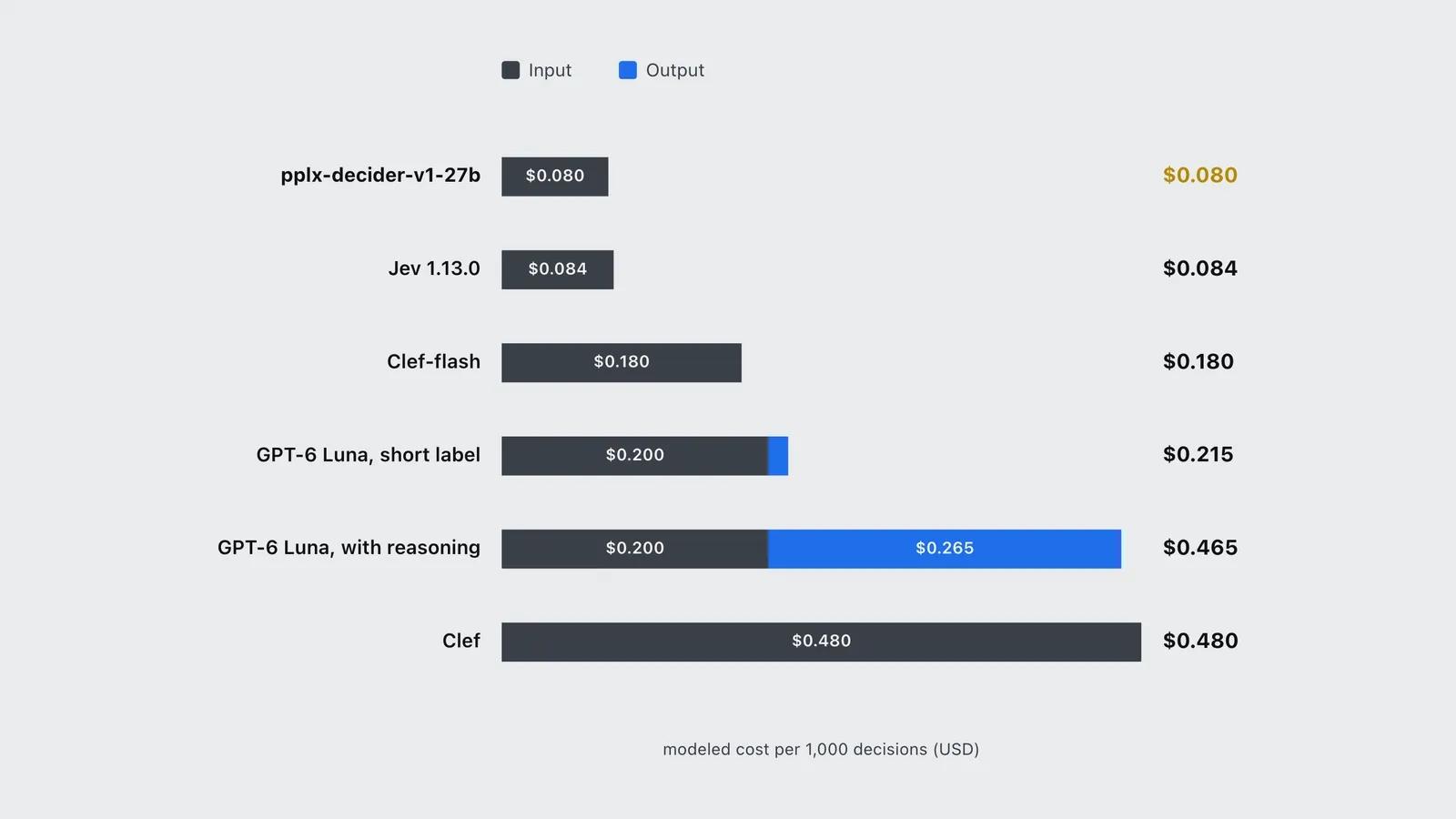
Only some of them, and the free output matters less than it sounds. A chat model asked for a one-word label writes very little, so its output bill is small. The input rate decides the cost, and on input, Clef is more expensive than the cheapest chat tier on the market.
| Scenario | Input | Output | Total |
|---|---|---|---|
| pplx-decider-v1-27b | $0.080 | $0.000 | $0.080 |
| Jev 1.13.0 | $0.084 | $0.000 | $0.084 |
| Clef-flash | $0.180 | $0.000 | $0.180 |
| GPT-6 Luna, short label | $0.200 | $0.015 | $0.215 |
| GPT-6 Luna, with reasoning | $0.200 | $0.265 | $0.465 |
| Clef | $0.480 | $0.000 | $0.480 |
The model behind the chart is simple and every input is a list price. Each decision sends 2,000 tokens of state and question. GPT-6 Luna, OpenAI’s cheapest tier at $0.10 input and $0.50 output per million tokens on the OpenAI API pricing page, is costed two ways: answering with a 30-token label, and answering after about 500 tokens of reasoning.
Three things follow from it:
- pplx-decider and Jev are the only clear price wins. At $0.04 and $0.042 per million input tokens they cost less than half of a short-label Luna call, and the gap widens as soon as the chat model reasons.
- Clef-flash roughly ties a short-label Luna call ($0.180 against $0.215). Its case is speed and the probability on every answer, not a lower bill.
- Clef costs more than a short-label Luna call and about the same as a Luna call that reasons. Pick it for the calibrated probabilities, the open weights and staying inside Cloudflare’s network, not for price.
The chart leaves out what a decision model does not do: it cannot explain itself, write a reply or call a tool. The comparison holds only for jobs that end in a choice.
Which October decision model should you pick?
- Cheapest managed calls: pplx-decider-v1-27b at $0.04 per million input tokens, with images accepted alongside text.
- Lowest latency on a hosted API: Clef-flash, at a 38.8 ms median by Cloudflare’s measurement, already inside Workers AI if your app runs there.
- On your own hardware or offline: Strands Decider 2B. At 2B parameters it runs on a laptop GPU, and Strands ships the training data and scripts with the weights.
- Already on Azure: Microsoft-Decision-1 at $0.042, inside Foundry, if keeping traffic on one cloud matters more than shaving the rate.
- Already on Jev: there is no price reason to move. Jev’s $0.042 is within a fraction of a cent of pplx-decider per thousand calls, so test the accuracy on your own questions before switching.
How to get started with a decision model
- Pick five to ten decisions your app already makes with a chat model and a parsing step: ticket routing, moderation, a yes or no gate before a tool call.
- Log the inputs and the chat model’s answers for a few hundred real cases. That log is your test set.
- Run the same cases through pplx-decider-v1-27b or Clef-flash and compare agreement and the probability spread. Set a threshold below which the case falls back to the chat model.
- Price the switch with the chart’s method: your real input tokens per call times the input rate, against your current per-call bill.
Pareto 26.10 Preview: the first price cut of October
Two weeks after Pareto 26.9 launched at $2.50 and $7.50 per million tokens, Unbiased published a preview of its successor at $0.80 input, $0.03 cached input and $3.20 output, according to the Unbiased model card. That is 68% less on input and 57% less on output than the model it previews. The only benchmark published so far is Unbiased’s own, preliminary and vendor-run: 69.9% on DeepSWE v1.1 at $0.24 per task. Unbiased says the figures may change before final publication and that its cost method still needs confirming.
Treat the price as a preview price. Unbiased’s own listing on OpenRouter describes the model as a preview of the next Pareto version and points stable workloads at Pareto 26.9.
Microsoft MAI speech models: what does $0.54 an hour buy?
Microsoft shipped three speech models on October 1, all generally available, per its announcement Our first streaming transcription model debuts at no. 1 on Artificial Analysis:
- MAI-Transcribe-2-Streaming transcribes speech as it arrives, in 60 languages. Microsoft cites the independent Artificial Analysis AA-WER Streaming evaluation, where it ranks first at a 2.5% word error rate with the final transcript ready 0.13 seconds after the speaker stops. It costs $0.54 per audio hour at an introductory rate that runs through the end of 2026.
- MAI-Voice-2.1 is text-to-speech across 23 languages and 26 locales at $22 per million characters, and keeps a single voice natively accented in every language.
- MAI-Voice-2.1-Flash generates 45 seconds of audio at about 150 ms end-to-end latency for $15 per million characters, 32% less than the full model.
The streaming transcriber is the one to watch for cost. A voice agent pays for every second of audio the caller speaks, so the year-end expiry of the introductory rate is a date to put in the budget now, not in January.
FLUX 3 Image: what does an image cost?
Black Forest Labs announced FLUX 3 in July as one network for image, video, audio and robot actions. FLUX 3 Image is the image half reaching the API, dated October 1 in the Black Forest Labs release notes. It takes up to ten reference images, places elements by bounding box and renders in 15 aspect ratios. Pricing is per image, by resolution:
| Resolution | Price per image |
|---|---|
| 768 square | $0.041 |
| 1K | $0.048 |
| 2K | $0.100 |
| 4K | $0.607 |
The step to 4K is the one to notice: a 4K image costs six times a 2K one.
Tavus Griffin-Lite: a video model you cannot buy yet
Tavus describes Griffin as a full-duplex video-to-video model: it watches, listens and replies in speech and video at once, rather than passing a call through separate speech, language and video systems. Only the smaller Griffin-Lite is out, as a research preview for invited testers, per the Tavus Griffin page. The full model is held back until safety concerns are addressed. Tavus reports a score of 3.83 out of 5 on NVIDIA’s VideoFDB generation benchmark, against a human reference of 3.92 and 2.80 for the next system. In a company-run test, 26 of 54 people (48%) believed after a one-minute call that they had been talking to a real person. No price is published.
The release pace
October has eighteen releases in twelve days, ten of them on October 1. For comparison, the release archive counts 5 tracked releases in June (from June 9, when the record starts), 21 in July, 12 in August and 34 in September. October opened without a frontier launch: the largest models of the first week, Mistral Large 4 and Beam, are open-weight contenders rather than new leaders, and Anthropic’s release was its smallest tier. The first frontier-tier release came on October 12, and it came from Meta, not from OpenAI, Google or Anthropic.
Several models appear on other October lists but not this one, because their own announcements date them elsewhere. Liquid d1, Mercury Voice and Mercury Decide, GLiDE, Ant Group’s Ling-3.1-flash and Bilibili’s Index-Translate all launched on September 29 or 30. Apodex 1.1 Mini appears as an October 1 release on one gateway, but its weights shipped with Apodex 1.1 at the start of September; October 1 is when the gateway listed it. GPT-Synopsys, announced by OpenAI and Synopsys on September 30, is a partnership to build a chip-design model, not a model anyone can use yet. Every date on this page is read off the lab’s own announcement or documentation. The method is set out in the AI model release archive.
Did OpenAI release a new model in October 2026?
Not as of October 13, 2026. OpenAI’s most recent release is GPT-6.1 Sol, shipped at DevDay on September 29 at $2 input and $10 output per million tokens with the cache read halved to $0.10. Its cheapest current tier, GPT-6 Luna at $0.10 and $0.50, launched on September 22. Both are covered in the September roundup, and current rates for every OpenAI model are in the AI model tracker.
Did Google or Anthropic release a new model in October 2026?
Both did, but neither shipped a new flagship. Anthropic released Claude Haiku 5.5 on October 7, its small tier, at $0.10 and $0.50 per million tokens for prompts up to 100,000 tokens, and halved the Sonnet 5.5 cache read the same day. Google released the image model Nano Banana 2.1 on October 6. Google’s latest language model is still Gemini 4 Argon, announced on September 30 at an introductory $2 and $10 per million tokens and limited to cyber defenders in its Fairwind Program; the detail is in the Gemini 4 Argon breakdown.
Frequently asked questions
- What AI models were released in October 2026?
- As of October 13, 2026, eighteen. Meta released Muse Wonder on October 12 as an API preview at $4 and $20 per million tokens, with Muse Wonder Full available only in its Muse Code plans. On October 9 Microsoft released the decision model Microsoft-Decision-1 at $0.042 per million input tokens and Alibaba released Qwen-Image-2.1-Turbo at $0.014 an image. Anthropic released Claude Haiku 5.5 on October 7 at $0.10 and $0.50 per million tokens for prompts up to 100,000 tokens. Mistral opened a public preview of Mistral Large 4 on October 6 at a launch-sale $0.68 and $2.09, and Google released the image model Nano Banana 2.1 the same day. Reflection AI announced the open-weight Beam on October 5 with waitlist access only. The other ten landed on October 1: Perplexity released pplx-decider-v1-27b at $0.04 per million input tokens with free output; Cloudflare released Clef at $0.24 and Clef-flash at $0.09, also with free output; AWS Strands Labs released the self-hosted Strands Decider 2B. Unbiased released Pareto 26.10 Preview at $0.80 input and $3.20 output. Microsoft released MAI-Transcribe-2-Streaming at $0.54 per audio hour, MAI-Voice-2.1 at $22 per million characters and MAI-Voice-2.1-Flash at $15. Black Forest Labs released FLUX 3 Image at $0.041 to $0.607 per image, and Tavus opened Griffin-Lite as an invite-only research preview with no price. No OpenAI, xAI or DeepSeek model has launched in October so far.
- What is the cheapest decision model in October 2026?
- Perplexity pplx-decider-v1-27b, at $0.04 per million input tokens with output free, just under the $0.042 that TypeSafe Jev and Microsoft-Decision-1 charge. Cloudflare Clef-flash costs $0.09 and Clef $0.24 per million input tokens, also with free output. Strands Decider 2B has no hosted rate; you run it on your own hardware.
- Is a decision model cheaper than GPT-6 Luna?
- Only pplx-decider and Jev are clearly cheaper. On a modeled 1,000 decisions at 2,000 input tokens each, pplx-decider costs $0.080 and Jev $0.084, against $0.215 for GPT-6 Luna answering with a short label. Clef-flash costs $0.180, roughly a tie, and Clef costs $0.480, more than a short-label Luna call and about the same as a Luna call with 500 reasoning tokens.
- Did any AI model get cheaper in October 2026?
- Three so far. Unbiased Pareto 26.10 Preview, released October 1, lists at $0.80 input and $3.20 output per million tokens, 68% and 57% below the $2.50 and $7.50 that Pareto 26.9 launched at. On October 6 Google priced Nano Banana 2.1 image output at half the Nano Banana 2 rate, though its input rate tripled. On October 7 Anthropic halved the Claude Sonnet 5.5 cache read to $0.10 per million tokens and launched Claude Haiku 5.5 at a tenth of the Haiku 4.5 price.
- How many AI models has the release archive tracked through October 2026?
- Ninety dated launches from June 9, 2026: 5 in June, 21 in July, 12 in August, 34 in September and 18 in October as of October 13. Every row carries the price the model launched at and a link to the provider primary source.
Sources
Cloudflare (2026). Clef: open decision models. Cloudflare blog, October 1, 2026: Apache 2.0, 64K context, vendor-measured median and p95 decision times. https://blog.cloudflare.com/clef-decision-models/ Verified 2026-10-04.
Cloudflare (2026). Clef and Clef-flash. Workers AI model documentation: $0.24 and $0.09 per million input tokens, 65,536-token context. https://developers.cloudflare.com/workers-ai/models/clef/ and https://developers.cloudflare.com/workers-ai/models/clef-flash/ Verified 2026-10-04.
AWS Strands Labs (2026). Introducing Strands Decider 2B: a small, open source, decision model. Strands Agents blog, October 1, 2026. https://strandsagents.com/blog/introducing-strands-decider/ Verified 2026-10-04.
Perplexity (2026). Decisions API. Perplexity API documentation: pplx-decider-v1-27b, $0.04 per million input tokens, output free. https://docs.perplexity.ai/docs/decisions/quickstart Verified 2026-10-04.
Perplexity (2026). pplx-decider-v1-27b. Hugging Face model card: Qwen3.8-27B base, Apache 2.0, vendor benchmark table. https://huggingface.co/perplexity-ai/pplx-decider-v1-27b Verified 2026-10-04.
TypeSafe (2026). Models. TypeSafe documentation: jev-1.13.0 at $0.042 per million input tokens, output free. https://docs.typesafe.ai/models Verified for this site’s Jev post.
OpenAI (2026). API pricing. OpenAI developer documentation, GPT-6 Luna at $0.10 input and $0.50 output per million tokens. https://developers.openai.com/api/docs/pricing Verified 2026-09-23.
Unbiased (2026). Pareto 26.10 Preview model card. Unbiased, October 1, 2026: $0.80 input, $0.03 cached input, $3.20 output per million tokens; preliminary vendor-run benchmarks. https://unbiased.ai/model-card/ Verified 2026-10-04.
Microsoft AI (2026). Our first streaming transcription model debuts at no. 1 on Artificial Analysis. Microsoft AI news, October 1, 2026: MAI-Transcribe-2-Streaming, MAI-Voice-2.1 and MAI-Voice-2.1-Flash, prices and availability. https://microsoft.ai/news/our-first-streaming-transcription-model/ Verified 2026-10-04.
Black Forest Labs (2026). Release notes. BFL documentation, FLUX 3 Image entry dated October 1, 2026, with per-image pricing by resolution. https://docs.bfl.ai/release-notes Verified 2026-10-04.
Tavus (2026). Griffin: The First Human Interaction Model. Tavus, October 1, 2026: Griffin-Lite research preview, VideoFDB scores, company-run human study. https://www.tavus.io/griffin Verified 2026-10-04.
Anthropic (2026). Introducing Claude Haiku 5.5. Anthropic, October 7, 2026: rates by prompt length, the Sonnet 5.5 cache-read cut, vendor-reported benchmarks. https://www.anthropic.com/claude-haiku-5-5 Verified 2026-10-08.
Anthropic (2026). Pricing. Claude Platform documentation: Claude Haiku 5.5 at $0.10/$0.50 up to 100K tokens and $0.50/$2.50 above. https://platform.claude.com/docs/en/about-claude/pricing Verified 2026-10-08.
Mistral AI (2026). Introducing Mistral Large 4. Mistral blog, October 6, 2026. https://mistral.ai/news/mistral-large-4/ Verified 2026-10-08.
Mistral AI (2026). Mistral Large 4. Mistral documentation: 1.05T total and 52B active parameters, 1M context, launch-sale and standard rates. https://docs.mistral.ai/models/mistral-large-4-0 Verified 2026-10-08.
Reflection AI (2026). Introducing Beam: Reflection’s 501B open-weight model. Reflection blog, October 5, 2026. https://reflection.ai/blog/introducing-beam Verified 2026-10-08.
Meta (2026). Introducing Muse Wonder and Muse Wonder Full. Meta Newsroom, October 12, 2026. https://about.fb.com/news/2026/10/introducing-muse-wonder-models/ Verified 2026-10-13.
Meta (2026). Pricing and rate limits and Models. Meta Model API documentation: Muse Wonder at $4, $0.20 cached and $20 per million tokens; Muse Wonder Full in Muse Code only. https://dev.meta.ai/docs/pricing-rate-limits and https://dev.meta.ai/docs/models Verified 2026-10-13.
Artificial Analysis (2026). Muse Wonder model page and Models leaderboard. https://artificialanalysis.ai/models/muse-wonder and https://artificialanalysis.ai/leaderboards/models Read 2026-10-13.
Microsoft (2026). Introducing Microsoft-Decision-1 in Microsoft Foundry for decision and classification. Azure AI Foundry blog, October 9, 2026. https://techcommunity.microsoft.com/blog/azure-ai-foundry-blog/introducing-microsoft-decision-1-in-microsoft-foundry-for-decision-and-classific/4562742 Verified 2026-10-13.
Alibaba Cloud (2026). Qwen-Image-2.1-Turbo. Model Studio documentation, per-image price by region; weights at https://huggingface.co/Qwen/Qwen-Image-2.1-Turbo (repository created 2026-10-09). https://www.alibabacloud.com/help/en/model-studio/qwen-image-2-1-turbo Verified 2026-10-13.
Google (2026). Gemini API release notes. Entry dated October 6, 2026: Gemini Nano Banana 2.1 generally available. https://ai.google.dev/gemini-api/docs/changelog Verified 2026-10-08.
Google (2026). Gemini Developer API pricing. Nano Banana 2.1 and Nano Banana 2 rates. https://ai.google.dev/gemini-api/docs/pricing Verified 2026-10-08.
Artificial Analysis (2026). Claude Haiku 5.5 and Mistral Large 4 Preview model pages. Intelligence Index and cost per task. https://artificialanalysis.ai/models/claude-haiku-5-5 and https://artificialanalysis.ai/models/mistral-large-4 Read 2026-10-08.
Fastino Labs (2026). Introducing GLiDE: The First Thinking Decision Model. Fastino blog, September 30, 2026. https://fastino.ai/blog/introducing-glide-the-first-thinking-decision-model Verified 2026-10-04.
MarkTechPost (2026). Liquid AI Releases d1. Secondary coverage dating Liquid AI’s d1 to September 29, 2026. https://www.marktechpost.com/2026/09/29/liquid-ai-releases-d1-a-decision-model-that-returns-calibrated-probabilities-with-zero-output-tokens/ Read 2026-10-04.
Monthly release counts are derived from the release archive maintained on this site, whose every row carries the provider primary source it was verified against. The cost-per-1,000-decisions figures are this site’s arithmetic on the list prices above.