New AI Models Released in September 2026: Prices
Every AI model released in September 2026, with dates, verified per-token prices and a primary source for each. Updated through the month as releases land.
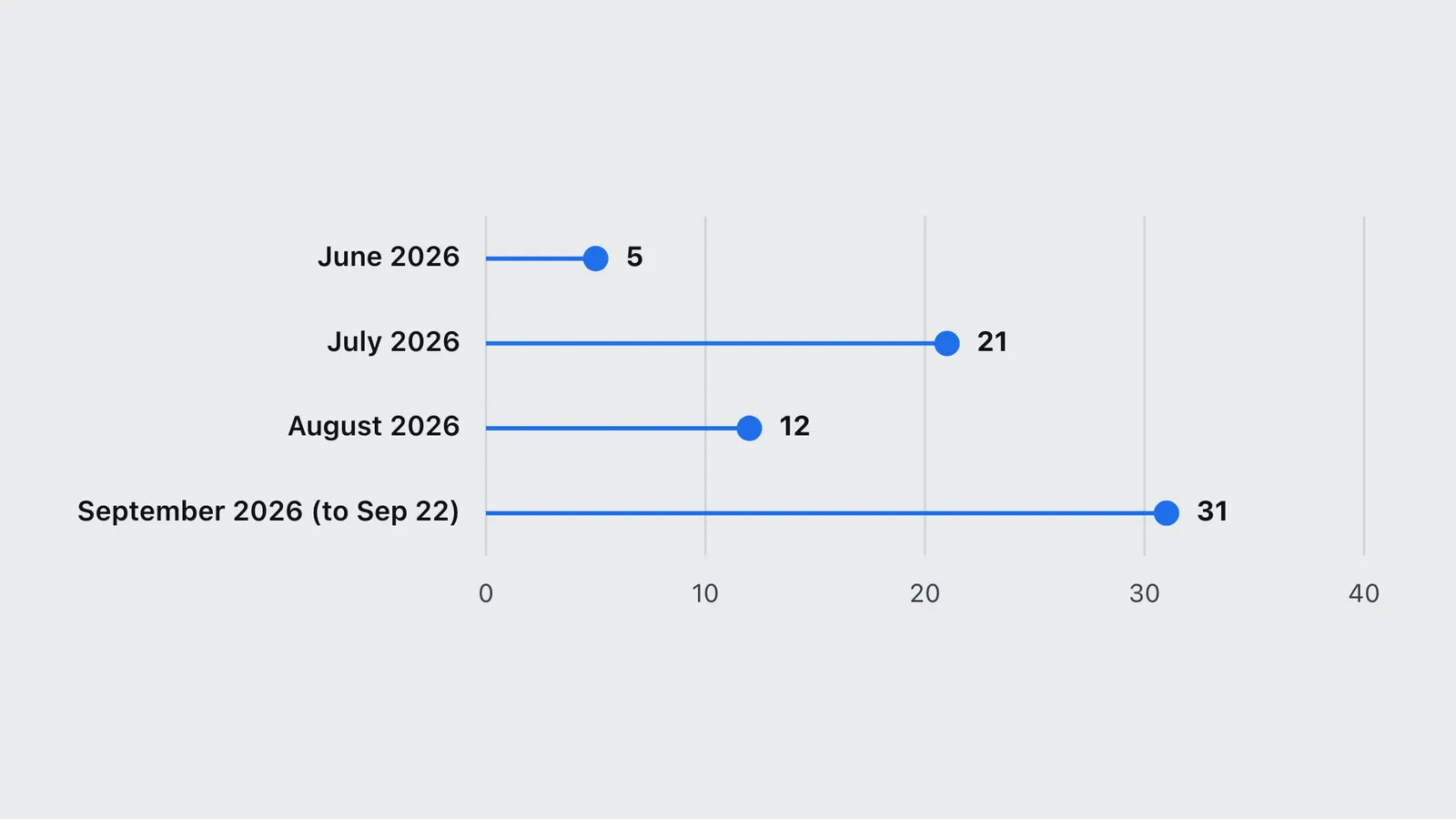
Thirty-four models were released in September 2026, across fourteen labs and thirty days. Anthropic opened on September 1 with Claude Fable 5.1 and its invitation-only twin Claude Mythos 5.1. Google and Meta both shipped on September 2: Gemini 3.8 Flash with a restricted Gemini 3.8 Flash Cyber variant, and Muse Spark 1.3. Alibaba refreshed its flagship the same day with the Qwen3.8-Max-0902 snapshot, and September 3 brought two launches at once: OpenAI released GPT-6 Astra, and Abu Dhabi’s Institute of Foundation Models shipped the six-model K2 Horizon open-weight fleet. The second week added two domain fine-tunes from Ant Group, two OpenAI image models, and the month’s most consequential rate change from DeepSeek. September 10 and 11 then brought a coding and orchestration wave: Cognition’s SWE-2, OpenAI’s GPT-Live-1 voice model, Sakana’s Fugu Max and Ultra v2 orchestrators, and Moonshot’s Kimi K2.8 Preview. September 15 added voice and verifiability: Google’s Gemini 3.8 Live pair and Gensyn’s open-1b, the first model with independently auditable training. September 16 and 17 added the month’s second stealth story: Union Alpha appeared anonymously and unmasked 33 hours later as Unbiased Pareto 26.9, a blended model at $2.50 and $7.50 per million tokens. The last week was the frontier’s: xAI shipped Grok 4.7 on September 21, OpenAI halved its reasoning and high-volume tiers with GPT-6 Sol and Luna on September 22, Anthropic launched Claude Opus 5.5 under the price of the Opus 5 it replaced the same day, followed on September 28 with Claude Sonnet 5.5 on Sonnet 5’s unchanged rate card, and OpenAI answered at DevDay on September 29 with GPT-6.1 Sol, the same $2 and $10 as GPT-6 Sol with the cache read halved again. Google closed the month on September 30 by announcing Gemini 4 Argon, its first Gemini 4 model, at an introductory $2 and $10 that so far reaches only cyber defenders.
For three days the story was that nobody was changing a price. Fable 5.1 holds Fable 5 rates, Gemini 3.8 Flash holds Gemini 3.7 Flash rates, Muse Spark 1.3 holds Muse Spark 1.2 rates, and Qwen3.8-Max-0902 holds the August Qwen3.8-Max rates. What moved in those six launches was a cache rate, a scheduled expiry, and the capability delivered per dollar.
Then OpenAI broke it in one direction and DeepSeek broke it in the other. GPT-6 Astra lists at $10 input and $50 output per million tokens, two and a half times the $4 and $20 that GPT-5.6 Sol charges, and the first increase at the frontier tier in years. Seven days later DeepSeek V4.1 Flash cut its own efficiency tier by 32% on input and 57% on the cache read. Any summary of September as either a price rise or a price cut is a summary of half the month.
The catch on the rise, and the reason this month is more interesting than a price-rise headline, is that Astra is also the cheapest way to finish a task on the one public leaderboard that publishes what a run costs.
September 1, 2026
Claude Fable 5.1 and Claude Mythos 5.1 released
Anthropic held Fable 5 rates at $10 input and $50 output per million tokens and cut only the cache read, from $1.00 to $0.25. Mythos 5.1 shares the specifications and the price but stays restricted to invited Project Glasswing participants.
September 1, 2026
The scheduled Claude Sonnet 5 increase did not happen
Sonnet 5 launched at $2 and $10 per million tokens, described as introductory pricing through August 31 with a rise to $3 and $15 due on that date. Anthropic cancelled it in August; the pricing documentation now records $2 and $10 as the standard rate.
September 2, 2026
Google Gemini 3.8 Flash and Gemini 3.8 Flash Cyber released
Google held the $0.75 and $3.75 per million token rate that Gemini 3.6 Flash and Gemini 3.7 Flash already carry. All three share one expiry: the rate is introductory through December 31, 2026 and doubles on January 1, 2027. The Cyber variant is restricted to the Fairwind Program for governments, critical infrastructure operators and software maintainers.
September 2, 2026
Meta Muse Spark 1.3 released
Meta held the $1.25 and $4.25 per million token rate card of Muse Spark 1.2 and moved the independent Artificial Analysis Intelligence Index from 57 to 61 at xhigh effort, on the scale AA used at launch. The max reasoning setting was held back for extra safety testing and opened to all developers on September 4 at the same rate.
September 2, 2026
Alibaba Qwen3.8-Max-0902 snapshot released
Qwen held the $2 and $6 per million token rate of the August Qwen3.8-Max and changed only the post-training, aimed at coding and cowork tasks. The qwen3.8-max endpoint upgrades to the snapshot automatically on September 5 with billing unchanged.
September 3, 2026
IFM K2 Horizon fleet released: six open models
Abu Dhabi's Institute of Foundation Models shipped six Apache 2.0 models from a 0.9B edge model to a 375B mixture-of-experts flagship, with training data, code and checkpoints published. No first-party per-token rate: API access runs through inference partners.
September 3, 2026
OpenAI GPT-6 Astra released
OpenAI raised the frontier rate for the first time in years, to $10 input and $50 output per million tokens, against $4 and $20 for GPT-5.6 Sol. Prompts over 272,000 tokens are billed at double, with output at $75. It went straight to the top of the independent Terminal-Bench 4.0 board at 58.18%, and costs less per solved task than any model above 20% accuracy.
September 4, 2026
Ant Group Ling-3.0-flash-Sante released
A health and medicine tuning of the July Ling-3.0-flash base, 124B total parameters and 5.1B active on a 262,144-token context. Hosted API only: no weights were published and Ant Group lists no rate card of its own for it.
September 8, 2026
OpenAI GPT Image 2.5 Flare and Sunburst released
Two API variants of the ChatGPT Images 2.5 model, Flare the faster default and Sunburst the slower precision option, both at $8 per million image input tokens and $30 per million image output tokens. Unusually for an image model, they are billed per token rather than per image.
September 9, 2026
Ant Group Ling-3.0-flash-Fin released
Announced at the 2026 Inclusion Conference on the Bund: the same 124B base continued-trained on financial data, with MIT weights published. Ant Group publishes no per-token rate for it, so every price a reader sees comes from a third-party host.
September 10, 2026
DeepSeek V4.1 Flash released, the month's only price cut
Peak rates of $0.30 input and $1.20 output per million tokens, against $0.44 and $1.32 for the V4 Flash it retires, with the cache read down from $0.014 to $0.006. A 552B mixture-of-experts on a new causal encoder-decoder architecture that activates only 8B parameters per token on prefill. MIT weights.
September 10, 2026
The DeepSeek V4 Pro retirement was announced, then reversed
The launch announcement said every deepseek-v4-pro request would be answered by V4.1 Flash from 04:00 UTC on September 14. The API documentation now says V4 Pro service continues past that date in response to user demand, with billing unchanged. V4 Flash and V4 Flash Vision Exp are genuinely retired.
September 10, 2026
Cognition SWE-2 and OpenAI GPT-Live-1 released
Cognition post-trained SWE-2 from the 2.8T-parameter Kimi K3 base, reaching 50.0% on FrontierCode 1.1 within a point of Fable 5.1 at 64% lower cost, available in Devin with no API rate. OpenAI brought its full-duplex GPT-Live-1 voice model to the API at $0.05 per minute billed per second, with backend reasoning billed separately.
September 11, 2026
Sakana Fugu Max and Ultra v2 plus Kimi K2.8 Preview released
Sakana split its orchestrator into a $2 and $6 cost tier (Max) and a $5 and $30 capability tier (Ultra v2), both routing across a pool of open models with no Fable or Astra inside. Moonshot rolled K2.8 Preview out to every Kimi Code user under the unchanged kimi-for-coding id, with 1M context on all tiers and no published rate.
September 15, 2026
Google Gemini 3.8 Live pair and Gensyn open-1b released
Google shipped its most advanced live dialogue models, 3.8 Live for scale and an Extended Thinking variant that tops the Speech to Speech Quality Index at 82.6, with no per-token rate published. Gensyn shipped open-1b, a 1.61B Apache 2.0 model whose all 80,957 training steps carry hashes anyone can replay and verify.
September 16 to 17, 2026
Union Alpha unmasked as Unbiased Pareto 26.9
A free anonymous listing with a 262,144-token context window went paid after about 33 hours and gained a name: Pareto 26.9, a blended composite from Unbiased at $2.50 input and $7.50 output per million tokens. The full spec sheet and modeled cost are in our Union Alpha post.
September 28, 2026
Anthropic Claude Sonnet 5.5 released
Anthropic kept every line of the Sonnet 5 rate card, $2 and $10 per million tokens with a $0.20 cache read, and claimed up to 30% less per task from fewer tokens and tool calls. Artificial Analysis scores it 56 at max effort, up from 38, but measures a higher cost per index task than Sonnet 5.
September 29, 2026
OpenAI GPT-6.1 Sol released at DevDay
One week after GPT-6 Sol, OpenAI shipped its upgrade at the same $2 and $10 per million tokens with cached input halved from $0.20 to $0.10. Artificial Analysis scores it 52 at max effort, up from 48 and one point behind GPT-6 Astra at a fifth of its price. The same keynote added an Ultrafast tier on Astra at six times standard.
September 30, 2026
Google Gemini 4 Argon announced
Google announced its first Gemini 4 model at an introductory $2 and $10 per million tokens, rising to $4 and $20 after an undated introductory period, with a 1M-token output limit. It is rolling out to cyber defenders in the Fairwind Program first; paid API and AI Ultra access has no date. Artificial Analysis scores it 53 at high effort, level with GPT-6 Astra.
Every AI model released in September 2026
| Model | Provider | Released | Input / output per Mtok | What it is |
|---|---|---|---|---|
| Claude Fable 5.1 | Anthropic | Sep 1 | $10 / $50 | Frontier flagship. Fable 5 rates held, cache read cut to $0.25 |
| Claude Mythos 5.1 | Anthropic | Sep 1 | $10 / $50 | Same model, safeguards lifted in some areas. Project Glasswing invitation only |
| Gemini 3.8 Flash | Sep 2 | $0.75 / $3.75 | Workhorse Flash tier. Rate held from 3.7 Flash, and doubles on Jan 1, 2027 | |
| Gemini 3.8 Flash Cyber | Sep 2 | Not published | Vulnerability-hunting variant. Fairwind Program access only | |
| Muse Spark 1.3 | Meta | Sep 2 | $1.25 / $4.25 | Agentic flagship. Rate held from 1.2. Max reasoning open to all from Sep 4 |
| Qwen3.8-Max-0902 | Alibaba | Sep 2 | $2 / $6 | Flagship snapshot. Same base and rate, post-training aimed at coding |
| GPT-6 Astra | OpenAI | Sep 3 | $10 / $50 | New frontier flagship. 2.5x the GPT-5.6 Sol rate, and tops Terminal-Bench 4.0 |
| K2 Horizon 375B-A23B | IFM | Sep 3 | Not published | Open-weight flagship. 375B MoE, 23B active. Apache 2.0 with training records |
| K2 Horizon 36B-A4B | IFM | Sep 3 | Not published | Sparse MoVA model. 36B total, 4B active. Apache 2.0 with training records |
| K2 Horizon 32B | IFM | Sep 3 | Not published | Dense local-serving model. Apache 2.0 with training records |
| K2 Horizon 7B | IFM | Sep 3 | Not published | Phone-scale dense model. Apache 2.0 with training records |
| K2 Horizon 3.7B | IFM | Sep 3 | Not published | Phone-scale dense model. Apache 2.0 with training records |
| K2 Horizon 0.9B | IFM | Sep 3 | Not published | Watch-scale dense model. Apache 2.0 with training records |
| Ling-3.0-flash-Sante | Ant Group | Sep 4 | Not published | Health and medicine fine-tune of Ling-3.0-flash. Hosted API only, no weights |
| GPT Image 2.5 Flare | OpenAI | Sep 8 | $8 / $30 | Faster default image variant. Billed per token, not per image |
| GPT Image 2.5 Sunburst | OpenAI | Sep 8 | $8 / $30 | Precision image variant, slower to generate. Same rate as Flare |
| Ling-3.0-flash-Fin | Ant Group | Sep 9 | Not published | Finance fine-tune of Ling-3.0-flash, MIT weights. No first-party rate card |
| SWE-2 | Cognition | Sep 10 | Not published | Kimi K3 post-train, 50.0% FrontierCode 1.1. Devin-only, no API rate |
| DeepSeek V4.1 Flash | DeepSeek | Sep 10 | $0.30 / $1.20 | The month’s only cut: 32% off input, 57% off the cache read. MIT weights |
| GPT-Live-1 | OpenAI | Sep 10 | Not published | Full-duplex voice in the API. $0.05 per minute, backend billed separately |
| Fugu Max | Sakana | Sep 11 | $2 / $6 | Cost-tier orchestrator over open models. 40 to 60% below Sonnet 5 output |
| Fugu Ultra v2 | Sakana | Sep 11 | $5 / $30 | Capability-tier orchestrator. $10/$45 past 272K tokens |
| Kimi K2.8 Preview | Moonshot | Sep 11 | Not published | Mid-tier preview, 1M context all tiers. Same kimi-for-coding id, no rate |
| Gemini 3.8 Live | Sep 15 | Not published | Scale-tier live dialogue model. 97 languages, no per-token rate | |
| Gemini 3.8 Live Extended Thinking | Sep 15 | Not published | High-reasoning live model. S2S Quality 82.6, 131K input | |
| open-1b | Gensyn | Sep 15 | Not published | 1.61B Apache 2.0 model. Every training step independently replayable |
| Jev 1.13 | TypeSafe | Sep 15 | $0.042 / free | Decision model, not a text model. Returns typed values with probabilities |
| Pareto 26.9 | Unbiased | Sep 17 | $2.50 / $7.50 | Blended composite, unmasked from Union Alpha. Vendor DeepSWE 74, ties Astra |
| Grok 4.7 | xAI | Sep 21 | $2 / $6 | Flagship. Rate held from 4.6. Terminal-Bench reads 38.0% or 25.8% by harness |
| Claude Opus 5.5 | Anthropic | Sep 22 | $4 / $20 | New frontier flagship. First to launch under its predecessor, cache read $0.20 |
| GPT-6 Sol | OpenAI | Sep 22 | $2 / $10 | Reasoning tier halved. Lands on exactly the Claude Sonnet 5 rate card |
| GPT-6 Luna | OpenAI | Sep 22 | $0.10 / $0.50 | High-volume tier halved. Cheapest row on the tracker |
| Claude Sonnet 5.5 | Anthropic | Sep 28 | $2 / $10 | Mid tier. Sonnet 5 rate held, AA index 38 to 56 at max effort |
| GPT-6.1 Sol | OpenAI | Sep 29 | $2 / $10 | GPT-6 Sol upgrade. Cache read halved to $0.10, AA index 48 to 52 at max effort |
| Gemini 4 Argon | Sep 30 | $2 / $10 (introductory) | Frontier. Fairwind cyber defenders first; $4 / $20 after an undated intro rate |
Every rate is read from the provider pricing documentation rather than from an announcement: the Claude Platform pricing documentation, the Gemini API pricing page, the Meta Model API pricing and rate limits page, the QwenCloud model page, the OpenAI API pricing documentation, the DeepSeek models and pricing documentation and the Sakana console pricing page. The two Claude models carry a 1M-token context window with 128K maximum output; Gemini 3.8 Flash carries 1M with 64K output, Muse Spark 1.3 carries 1,048,576 tokens, Qwen3.8-Max-0902 carries 1M with 131K output, GPT-6 Astra carries 1,050,000 with 128K output, and DeepSeek V4.1 Flash carries 1M with 384K output. The two Ling fine-tunes carry 262,144 tokens and no first-party rate at all. The six K2 Horizon models carry 524,288 tokens from the 3.7B up and 131,072 on the 0.9B, and none has a first-party rate either: API access runs through IFM’s inference partners. Of the September 10 to 15 arrivals, Kimi K2.8 Preview carries 1M tokens on every membership tier, Gemini 3.8 Live Extended Thinking carries 131,072 input tokens with 65,536 output, and Gensyn open-1b carries 4,096. Pareto 26.9, arriving September 17, carries 262,144 with 131,072 output. SWE-2 ships inside Devin only with no API rate, the two voice models bill per minute rather than per token, and Fugu’s orchestration tokens bill at the standard input and output rates above.
Gemini 4 Argon: a frontier price nobody outside Fairwind can pay yet
Google announced Gemini 4 Argon on September 30, the first model of the Gemini 4 generation it had confirmed was in pre-training back in July. The rate card is two cards. The introductory price is $2 per million input tokens and $10 output, with cached input 95% off at $0.10, and Google states that standard pricing of $4 and $20 applies afterwards without saying when the introductory period ends. The output limit rises to 1M tokens from 64K.
Almost nobody can buy it yet. Google is rolling Argon out first to trusted cyber defenders through its Fairwind Program, the same gate the Gemini 3.8 Flash Cyber variant ships behind, and says paid API customers and Google AI Ultra subscribers come next “as soon as possible”, with no date. It is not on the Gemini API pricing page as of October 1, which is why the tracker carries it as a preview rather than a general release.
The independent read is level rather than leading. Artificial Analysis scores Argon 53 on its Intelligence Index at high effort, tied with GPT-6 Astra at max and five behind Claude Opus 5.5. Google’s own table puts it first on DeepSWE v1.1 at 77.9% and on AutomationBench at 51.3%, both vendor-reported. What the introductory rate buys, and how the comparison with Astra and Opus 5.5 changes when it expires, is worked through in Gemini 4 Argon pricing and benchmarks.
Claude Fable 5.1: the sticker held, the cache read did not
Fable 5.1 was the month’s first launch and the only one to change a published rate at all. Every headline number matches Fable 5 exactly. Input $10, output $50, cache writes $12.50 for five minutes and $20 for an hour, batch at half price. The single change is the cache read, down from $1.00 to $0.25 per million tokens.
That rate is an exception in Anthropic’s own price list. Every other Claude model charges 10% of its base input rate for a cache hit. Fable 5.1 and Mythos 5.1 charge 2.5%.
| Tool | Cost per task | Multiple of baseline |
|---|---|---|
| Claude Fable 5 (until Sep 1) | $1.00 | - |
| Claude Opus 5 | $0.50 | - |
| Claude Fable 5.1 | $0.25 | - |
| Claude Sonnet 5 | $0.20 | - |
| Claude Haiku 4.5 | $0.10 | - |
Why that matters to a bill rather than a rate card: a coding agent re-reads the same file tree and conversation history on every step, so most of its input is cache hits. Modeled on the task profiles in the cost-per-task calculator, a long agentic run drops from $9.70 on Fable 5 to $7.68 on Fable 5.1, about 21%, with fresh input and output contributing nothing to the change. A small single-file edit saves only 11%, because less of its input comes from cache.
Anthropic quotes up to about 45% for highly agentic work. That figure needs a cache share above 93%, with essentially no output tokens. The full arithmetic, including why Fable 5.1 still never undercuts Opus 5 on a task that generates output, is in Claude Fable 5.1: pricing, benchmarks, cost.
Claude Opus 5.5: the first flagship to launch cheaper than the model it replaced
Anthropic released Claude Opus 5.5 on September 22 at $4 per million input tokens and $20 per million output, against the $5 and $25 that Opus 5 charged. Every line of the rate card fell by 20%: cache writes to $5 at five minutes and $8 at one hour, batch to $2 and $10, Fast mode to $8 and $40. The cache read fell further, from $0.50 to $0.20, because Anthropic’s pricing documentation halves the multiplier itself to 0.05x of input, where most Claude models bill 0.1x.
That is the notable part, and it is rarer than it sounds. In sixty-seven tracked releases going back to 2024, no Anthropic flagship had ever launched under the price of the one it replaced. Opus 5 held Opus 4.8’s rate exactly. Fable 5.1 held Fable 5’s. This is the first time the version number carried a cut.
Anthropic says the model costs 40% less to run than Opus 5 on typical workloads. The rate card accounts for roughly 24% of that on a blended basis, so the remainder depends on the claim that Opus 5.5 also finishes work in fewer tokens. That half is not yet independently measured, and the one public reading points the other way: Artificial Analysis records 260 million output tokens to run its Intelligence Index on Opus 5.5 against an 88 million median, and calls the model very verbose. It also ranks it first of 212 at 58 on that index.
The launch benchmarks, including 66.4% on Terminal-Bench 4.0, are Anthropic reporting on Anthropic. The independent Terminal-Bench 4.0 board had no Opus 5.5 entry as of September 23. Full working in Claude Opus 5.5 pricing and benchmarks.
Claude Sonnet 5.5: the same rate card, a higher bill on the independent index
Anthropic released Claude Sonnet 5.5 on September 28 as the second model in the Claude 5.5 family, and left every line of the Sonnet 5 rate card where it was: $2 per million input tokens, $10 output, a $0.20 cache read and $2.50 for a five-minute cache write, per Anthropic’s pricing documentation. Unlike Opus 5.5, it keeps the standard 0.1x cache multiplier.
Anthropic’s claim is that it costs up to 30% less per task than Sonnet 5 because it needs fewer tokens and tool calls, and that it writes output more than 30% faster. The speed half holds up independently: Artificial Analysis measures 141.9 output tokens per second against 81.3 for Sonnet 5. The cost half does not, on that service’s workload: its Intelligence Index costs $7.60 per task to run on Sonnet 5.5 at max effort, against $5.09 on Sonnet 5 and $5.98 on Opus 5.5. What the extra money buys is 18 points, 38 to 56, which puts Sonnet 5.5 third of 216 and two behind the flagship.
The launch benchmarks, including 70.6% on Terminal-Bench 4.0 against 10.3% for Sonnet 5, are Anthropic reporting on Anthropic. Full working, including when Sonnet 5.5 is and is not the cheaper Claude, is in Claude Sonnet 5.5 pricing and benchmarks.
GPT-6.1 Sol: a week-old tier, upgraded at the same price
OpenAI released GPT-6.1 Sol at its DevDay keynote on September 29, seven days after the GPT-6 Sol it upgrades. The headline rates did not move: $2 input and $10 output per million tokens on the OpenAI API pricing documentation, with long prompts above 272,000 tokens at $4 and $15. The line that did move is the cache read, halved from $0.20 to $0.10, which is 5 percent of fresh input. Sam Altman called it a 95 percent discount on stage. For a coding agent that re-sends its context every turn, the cache read is the most-billed line on the card, so this is a real cut delivered without touching the sticker.
The capability claim is that 6.1 Sol runs close to GPT-6 Astra at a fifth of Astra’s price, and the independent index broadly agrees: Artificial Analysis scores it 52 at max effort, up from 48 for GPT-6 Sol and one point behind Astra’s 53. The model page lists a 1,050,000-token context window with 128,000 output tokens and five reasoning-effort levels. What it does not have yet is Ultrafast: the new speed tier OpenAI launched the same day runs on Astra only, at six times standard, and Sol gets it at an unannounced date and price. What the rest of the keynote changed, including the new $500 Pro plan, is in the DevDay 2026 announcements recap.
GPT-6 Sol and Luna: the same day, the other direction
Hours after Anthropic shipped Opus 5.5, OpenAI released GPT-6 Sol and GPT-6 Luna, halving both tiers. Sol goes from $4 and $20 per million tokens to $2 and $10, with cached input from $0.40 to $0.20. Luna goes from $0.20 and $1.20 to $0.10 and $0.50.
OpenAI describes both as 50% cuts. Sol is exactly that on every line. Luna is not: input and cache halve, but output falls 58%, so on a blended basis the Luna cut is 55.7%. The company understates its own reduction on the tier where it cut hardest.
Two things make this the more consequential of the two September 22 launches for anyone budgeting. First, GPT-6 Sol lands on precisely the Claude Sonnet 5 rate card, matching all three lines at $2 input, $10 output and a $0.20 cache read, and Artificial Analysis scores it 48 at max effort against Sonnet 5 at 38. Identical price, and it wins at every effort level. Second, GPT-6 Luna at $0.10 and $0.50 is now the cheapest row on this site’s tracker, and Artificial Analysis runs its whole Intelligence Index on it for $0.07 against $5.98 on Claude Opus 5.5.
It also resolves a question this site had flagged for November. OpenAI had labelled Sol’s $4 / $20 promotional through November 21, 2026, with $5 / $30 as the published fallback. It answered two months early by shipping something cheaper instead. Full working in GPT-6 Sol and Luna pricing and benchmarks.
Gemini 3.8 Flash: the third Flash in a row at the same price
Google’s third Flash release in six weeks lists $0.75 per million input tokens and $3.75 per million output tokens, the same rate Gemini 3.6 Flash and Gemini 3.7 Flash already carry. So does the expiry attached to it. Google’s own pricing page marks all three as introductory through December 31, 2026, rising to $1.50 and $7.50 on January 1, 2027, with cached input going $0.075 to $0.15.
That is the fact worth carrying out of this month. Upgrading generation does not reset the clock, and there is no cheaper Flash generation to retreat to, because all three are the same rate card. A team budgeting 2027 from a September rate card understates a steady workload by two thirds.
Google reports 54.9% on HLE-Verified and says the model beats most larger frontier models on DeepSWE v1.1; both are vendor figures. Artificial Analysis, an independent benchmarking service, scores it 59 on its Intelligence Index at high effort, against 56 for Gemini 3.7 Flash.
Muse Spark 1.3: the rate card that has not moved in three releases
Meta shipped its fourth Muse Spark in five months at $1.25 and $4.25 per million tokens, unchanged since Muse Spark 1.1 in July. The cheaper contributor endpoint, $0.10 and $0.20 per million tokens in exchange for Meta using the prompts and completions sent to it, is unchanged too.
The change is capability per dollar. Artificial Analysis scored the xhigh configuration at 61 at launch, up from 57 for Muse Spark 1.2, which puts it level with GPT-5.6 Sol at max effort and ahead of Gemini 3.8 Flash. Meta also reports about 20% fewer tool calls and 25% fewer tokens per coding task than 1.2, a saving that reaches a bill without touching a rate.
The max reasoning setting, held back at launch for two more days of safety testing, opened to all developers on the Meta Model API and in Muse Code on September 4 at the same rate: reasoning tokens bill as output, so max costs more only by using more of them. On Artificial Analysis’s rescaled index, read September 29, max scores 48 against 45 for xhigh at $1.60 per index task against $1.37. Whether three points are worth 17% more per task is worked through in Muse Spark 1.3 Max vs xhigh.
Both September 2 launches, the January price cliff, and the modeled twelve-month bills are worked through in Gemini 3.8 Flash and Muse Spark 1.3 pricing.
Qwen3.8-Max-0902: the same flagship, retrained
Alibaba’s September 2 entry is a snapshot, not a new model underneath. Qwen3.8-Max-0902 keeps the August Qwen3.8-Max base, all 2.4 trillion parameters of it, and the $2 and $6 per million token rate, with implicit cache reads at $0.25. What changed is the post-training, extended on coding and on Cowork, the agentic office work Qwen measures with its own CoWorkBench.
The gains on Qwen’s own table are large where the August snapshot was weakest: Terminal-Bench 3.0 from 11.3 to 29.0, JobBench 53.4 to 64.0. Two footnotes travel with that table. Three of its benchmarks are Qwen in-house tests, and the rival column it beats is Fable 5, not the Fable 5.1 that shipped the same week. Treat the direction as signal and the margins as provisional.
The operational detail matters more than the benchmarks. On September 5 the qwen3.8-max endpoint upgrades to this snapshot automatically with billing unchanged, so pinned callers get the new post-training whether they asked for it or not. The snapshot is API-only: no weights were published for it, leaving the August base the most recent downloadable Qwen3.8.
GPT-6 Astra: the first frontier price rise in years
OpenAI ended the no-price-change run on September 3. GPT-6 Astra lists $10 per million input tokens and $50 per million output on the OpenAI API pricing documentation, against $4 and $20 for GPT-5.6 Sol. Cached input is $1 and cache writes are $12.50. Prompts above 272,000 tokens are billed at double for the whole request, with output at $75, and Fast mode is twice the standard rate.
Two things make that less simple than a 2.5x rise. The rate it is measured against was itself temporary: OpenAI flagged the Sol figures as promotional through November 21, 2026, and then replaced the tier entirely with GPT-6 Sol at $2 and $10 on September 22, which makes Astra 5x its own reasoning tier rather than 2.5x. And $10 and $50 is not a new high. It is exactly what Claude Fable 5.1 charged two days earlier.
The sticker is also the wrong number to judge it by. Terminal-Bench 4.0 publishes the dollar cost of every run alongside the score, and Astra went straight to the top of it at 58.18% across 330 trials. Dividing the published spend by solved trials, the arithmetic used throughout the Terminal-Bench 4.0 analysis here, Astra solves a task for $17.02 at max effort and $11.88 at high effort. Claude Fable 5.1 scores a statistically identical 57.88% and costs $32.69. Claude Opus 5 costs $34.91 for six points less.
The mechanism is token burn, not the rate card. Astra used 1.53 billion tokens across the benchmark. Fable 5.1 used 2.75 billion and Opus 5 used 6.53 billion. A model can charge two and a half times more per token and still be the cheapest way to finish the work.
K2 Horizon: six open models, one fleet
The same day Astra shipped, Abu Dhabi’s Institute of Foundation Models released six models at once, from a 0.9B model built for watches to a 375B mixture-of-experts flagship, all under Apache 2.0. Weights alone would be unremarkable at this point. What travels with them is the training process: data mixtures or construction recipes, code, configurations, intermediate checkpoints and fine-grained logs, through agentic post-training. No lab has published that much of how a model was built before.
The launch numbers need the usual vendor-table caution, plus one unusual credit. The flagship claims 70.2% on Terminal-Bench 2.1, then audits itself down to 66.9% for reward hacking and publishes the correction, and separately discloses that the 7B’s 82 on SWE-bench is a contaminated run that does not represent real performance. Independent measurement exists for the flagship: Artificial Analysis scored it 47 on the Intelligence Index at launch, just above MiniMax-M3 at 45. There is no rate card, so, like the Ling fine-tunes above, every price a reader finds comes from a third-party host rather than the lab.
DeepSeek V4.1 Flash: the month’s only price cut
DeepSeek released V4.1 Flash on September 10 and it is the only release this month that lowered a published rate. Peak input falls from $0.44 to $0.30 per million tokens against the V4 Flash it replaces, peak output from $1.32 to $1.20, and the cache read from $0.014 to $0.006. Off-peak, as always with DeepSeek, is exactly half of each.
Those three lines did not fall together, and the gap between them is the point.
| Item | Value |
|---|---|
| Cache read: $0.014 to $0.006 | 57.1% |
| Input: $0.44 to $0.30 | 31.8% |
| Output: $1.32 to $1.20 | 9.1% |
The cache read took the deepest cut by a wide margin, and that is the line an agent harness leans on hardest. The same mechanism the Fable 5.1 section above works through applies here in reverse: a coding agent re-reads the same file tree and conversation history on every step, so most of its input arrives as cache hits rather than fresh tokens. A rate card where the cache read falls 57% and the output only 9% is aimed squarely at long agentic runs, not at chat.
It is also a partial reversal. DeepSeek raised these same rates on August 16, when it moved to peak and off-peak billing, and the cache-hit line took the largest rise then too, 5.0x on the Flash tier. September gives back a little over half of that one increase while leaving the time-of-day structure untouched. Anyone whose bill jumped in August is not back where they started.
The architecture is the reason the cut was possible rather than a marketing decision. V4.1 Flash is a 552B-parameter mixture-of-experts on what DeepSeek calls a causal encoder-decoder: 40 layers split into a 20-layer causal encoder and a 20-layer decoder, with the decoder global KV cache projected from the final encoder hidden states rather than derived from each decoder layer separately. That activates only 8B parameters per token during prefill and 16B during decode, and an FP4 main KV cache holds 890 bytes per token, roughly a quarter of what V4 Flash needed. Prefill is the input-heavy half of an agentic workload, so the half DeepSeek made cheapest to serve is the half it discounted hardest. Weights are MIT-licensed and published on Hugging Face, which makes this the first September release anyone can download.
The release also retired two models. V4 Flash and the experimental V4 Flash Vision Exp are gone, though DeepSeek still accepts both model ids and serves them from V4.1 Flash at the V4.1 Flash price, so a caller pinned to the old id quietly gets the new model and a lower bill.
What happened to V4 Pro is worth recording carefully, because it changed twice in a day. The launch announcement said every deepseek-v4-pro request would be answered by V4.1 Flash from 04:00 UTC on September 14. The DeepSeek API documentation now states that V4 Pro service continues past that date in response to user demand, with the billing method unchanged, and points at a V4.1 Pro still to come. V4 Pro rates were re-verified unchanged for this update at $1.32 input and $3.96 output per million tokens at peak. A tracker that read the announcement and never re-read the docs is currently telling readers that V4 Pro is gone.
Ling-3.0-flash-Fin: a finance model with no price
Ant Group open-sourced Ling-3.0-flash-Fin on September 9 at the 2026 Inclusion Conference on the Bund, and shipped a health and medicine sibling, Ling-3.0-flash-Sante, five days earlier on September 4. Both are continued-training runs on the July Ling-3.0-flash base rather than new models: 124B total parameters, about 5.1B active per token, a 262,144-token context window. Fin publishes MIT weights; Sante, at the time of writing, does not.
Fin is the one worth a finance reader’s attention, because the thing it is tuned for is the workflow rather than the chat. Ant Group describes it as built with financial institutions for end-to-end financial research: retrieval, evidence review, calculation, modeling and report preparation, evaluated on FinFIRST, FinSearchComp Verified, FinCRAFT, Finance Agent, APEX-Agents, SpreadsheetBench and a banking agent benchmark. The press release quotes no head-to-head score against a named competitor, only that the model is competitive with much larger general-purpose models, so there is nothing here to rank yet.
The pricing line is the unusual part and the reason both rows carry no rate in the table above. Ant Group publishes no per-token rate card of its own for either model. Every price a reader will find comes from a third-party host, several of which are running them free as a launch promotion. That is a genuine cost advantage and a genuine planning risk at the same time: a promotional free tier is not a rate you can budget against, and there is no first-party card to fall back to when it ends.
SWE-2 and the orchestration wave: September 10 to 11
September 10 and 11 belonged to a different thesis from the rest of the month: stop training a bigger model, and orchestrate or distill the ones already here. Three of the four arrivals make that argument explicitly.
Cognition’s SWE-2 is post-trained from Moonshot’s Kimi K3, a 2.8T-parameter base that had already gone through extensive RL for agentic coding, and Cognition’s RL still found 5 to 6 points of headroom on many benchmarks. The headline is 50.0% on FrontierCode 1.1 Main against 50.9% for Fable 5.1 at 64% lower cost, with DeepSWE 1.1 at 73.0% against 67.4% for Fable 5.1. The honest footnote is the Terminal-Bench 4.0 row in Cognition’s own table: SWE-2 scores 27.3% there against 55.8% for Fable 5.1 and 57.9% for Astra, which says the Pareto claim holds on Cognition’s home benchmarks and fades on the one board both rivals top. There is no rate card because there is no API: SWE-2 ships in Devin Desktop, CLI, Web and Fusion only.
Sakana’s Fugu Max and Ultra v2 are the same core orchestration architecture split into two missions. Max asks what the best output at the lowest cost looks like: $2 input and $6 output per million tokens flat across context length, which Sakana prices 40 to 60% below Sonnet 5, GPT-5.6 Terra and Kimi K3 output, with best-overall scores on six of ten vendor benchmarks. Ultra v2 asks what maximum capability looks like: $5 and $30, rising to $10 and $45 past 272K tokens, with Chartography 48.3 against 27.3 for Opus 5 and DeepSWE 74.3. The disclosure that matters most is the pool: Fable 5, Fable 5.1 and GPT-6 Astra are not in Ultra v2’s agent pool, so those comparisons are orchestrated open models beating closed frontier models without borrowing them. Every figure in this paragraph is Sakana reporting on Sakana, and the usual vendor-table caution from the Astra and DeepSeek sections applies.
Moonshot’s Kimi K2.8 Preview is the quietest of the four and possibly the most widely deployed by accident: it rolled out fully inside Kimi Code under the unchanged kimi-for-coding id, so existing clients and third-party tools moved to it with no configuration change. Moonshot claims performance close to the K3 flagship with more efficient thinking than K2.7 Code, 1M context on every tier, and low, high and max thinking levels with max as default. It is proprietary, unlike the open-weight K2.7 Code and K3 around it, and Moonshot publishes no rate and no benchmark table for it, so treat the positioning as a changelog note rather than a measured result.
Voice week arrives early: GPT-Live-1 and Gemini 3.8 Live
Two voice models shipped five days apart, and they share an architecture idea: split the conversation from the reasoning. OpenAI’s GPT-Live-1 reached the API on September 10, a full-duplex model that listens and speaks simultaneously while delegating deeper reasoning and tool calls to a backend text model such as GPT-6 Astra. Voice sessions cost $0.05 per minute billed per second, with backend model and tool usage billed separately, which is why the table above carries no per-token rate for it. Google’s Gemini 3.8 Live and 3.8 Live Extended Thinking followed on September 15: the base model built for scale and cost efficiency, the Extended Thinking variant for multi-step reasoning that speaks while background tasks finish. Google’s numbers are strong where they are independent: 82.6 on the Artificial Analysis Speech to Speech Quality Index (first overall), 68.6% on tau-Voice agentic task completion, and second place in the Speech Agent Arena for the base model. Google publishes no rate for either, so production budgeting waits on a price page.
open-1b: the first auditable training run
Gensyn’s open-1b, released September 15, is the smallest model of the month and the most structurally novel. It is a 1.61B-parameter decoder-only model (1.08B non-embedding) trained on 400B tokens across 80,957 steps on 48 H100s, Apache 2.0 licensed, and unremarkable on benchmarks by design: 25.4 against 31.9 for OLMo 2 1B on the OLMo 2 suite. The release is not the weights but the proof. Every step carries a committed state hash over the batch, weights, gradients and optimizer state, chained to the previous step, with checkpoints every 100 steps and an audit harness that replays any step on commodity hardware (NVIDIA, x86, ARM, Apple Silicon) and compares hashes. The trick it solves is real: floating-point addition order differs across hardware, so Gensyn’s RepOps library and reproducible execution environment fix reduction orders and randomness to land on identical bits everywhere, at roughly 5% model FLOPs utilization, about 5 times slower than an optimized stack. Open weights hand over the cake, open recipes add the recipe card, and this adds a kitchen camera anyone can review. Whether labs adopt it is a separate question from whether it works; as a September release it is the only one competing on verifiability rather than capability per dollar.
The release pace
Thirty-four releases in thirty days is a fast month by any standard in this record. Set it against the three months before it and the shape is clearer.
| Item | Value |
|---|---|
| June 2026 | 5 |
| July 2026 | 21 |
| August 2026 | 12 |
| September 2026 | 34 |
July was the outlier, not August. The GPT-5.6 family alone contributed three of those twenty-one, and Claude Opus 5, Kimi K3 and the Gemini 3.5 tiers filled most of the rest. August settled to twelve. September passed that total inside ten days and passed July inside fifteen, and it did it with all four of the largest Western labs moving inside 72 hours of each other at the start, plus the largest fully open release in the record landing on day three.
Not all of those thirty-four are frontier models, and the distinction matters if you are reading the column as a measure of progress. Twelve were frontier launches, the last of them Gemini 4 Argon on the final day. The rest were workhorse and mid-tier releases, two access-restricted specialists, two image models, three voice models and nine open-weight releases, six of them from the single K2 fleet. Two of the thirty-four, OpenAI’s GPT Image 2.5 Flare and Sunburst on September 8, are image models that happen to be billed per token rather than per image, at $8 per million image input tokens and $30 per million image output, which is why they carry a rate here when the image and video rows from earlier months do not.
The month closed at thirty-four. Z.ai never moved, and Google’s next frontier model arrived on the last day as Gemini 4 Argon.
Two things that will appear on other September lists are deliberately not on this one. IBM Granite 4.2 is dated September 4 by at least one aggregated timeline; IBM released it on August 25, and September 4 is when a gateway added it. GPT-6 Astra Pro appears on another as a September 5 release; no such model exists in OpenAI’s pricing documentation. A third, Ant Group’s Ling-3.0-flash-Fin, is dated September 3 in the same way, six days before Ant Group announced it. Every date on this page is read off the lab’s own announcement or documentation, which is the whole reason the counts here run lower than an auto-ingested catalog. The method is set out in the AI model release archive.
Did OpenAI release a new model in September 2026?
Yes, seven. GPT-6 Sol and GPT-6 Luna followed on September 22 and GPT-6.1 Sol on September 29 at DevDay, at $2 and $10 with a $0.10 cache read. GPT-6 Astra was released on September 3, 2026 at $10 input and $50 output per million tokens, replacing GPT-5.6 Sol at the top of the lineup, and the GPT Image 2.5 Flare and Sunburst image variants followed on September 8 at $8 and $30 per million tokens. GPT-Live-1 reached the API on September 10: a full-duplex voice model at $0.05 per minute billed per second, with backend reasoning billed separately. Astra is the first increase in the frontier rate in years: Sol sits at $4 and $20, and those figures are themselves flagged promotional through at least November 21. Astra carries a 1,050,000-token context window, a five-step reasoning-effort dial and a knowledge cutoff of April 30, 2026, and it leads the independent Terminal-Bench 4.0 board at 58.18%.
Did Google release a new model in September 2026?
Yes. Gemini 3.8 Flash and the restricted Gemini 3.8 Flash Cyber arrived on September 2, at the same $0.75 and $3.75 per million tokens Gemini 3.7 Flash launched at on August 13. Google states on its own pricing page that this rate doubles to $1.50 and $7.50 on January 1, 2027, and the same expiry applies to 3.6 Flash and 3.7 Flash. On September 15 Google shipped Gemini 3.8 Live and 3.8 Live Extended Thinking, live dialogue models with no published rate: Extended Thinking tops the Speech to Speech Quality Index at 82.6. On September 30 Google announced Gemini 4 Argon, its first Gemini 4 model, at an introductory $2 and $10 per million tokens that rises to $4 and $20 when the undated introductory period ends; it is reaching only cyber defenders in the Fairwind Program so far.
Which September model should you actually use?
It depends on when the work runs and on whether you are buying tokens or buying finished tasks.
For work shipping this year, Gemini 3.8 Flash is the cheapest capable Western option: $0.73 on a modeled multi-step agentic task against $1.12 for Muse Spark 1.3 and $7.68 for Fable 5.1, and the fastest at 306 output tokens per second. DeepSeek V4.1 Flash undercuts all of them on the rate card at $0.30 and $1.20 at peak, and by half that off-peak, with the caveats that the peak window follows Beijing office hours rather than yours and that its benchmark claims are so far unaudited. For work running past January 1, price it at the doubled rate of $1.50 and $7.50, at which point Muse Spark 1.3 is cheaper per task and scores two points higher on the independent index.
For hard agentic work, the ranking inverts against the rate card. GPT-6 Astra is the most expensive of the month’s frontier launches per token and the cheapest per solved task on Terminal-Bench 4.0, at $11.88 at high effort against $32.69 for Fable 5.1 and $34.91 for Opus 5. Note that this is a measurement of a model inside a specific agent, Codex, and Fable 5.1 was measured inside Claude Code, so it is not a clean model-to-model comparison. Note too that Astra is not the most capable model by every measure: Artificial Analysis puts it at Intelligence Index 61 at max effort, behind Fable 5.1 at 66 and Opus 5 at 63.
Anthropic’s own guidance is to start with Claude Opus 5 and reach for Fable 5.1 only for demanding reasoning and long-horizon agentic work, or when Opus 5 at a higher effort setting still fails your evaluations. Opus 5 remains cheaper on every task profile that generates output.
The teams for whom September 1 was unambiguously good news are the ones already running Fable 5. For them this is roughly a fifth off the bill with no migration beyond three breaking API changes: forced tool use now returns an error, earlier models cannot read Fable 5.1 thinking blocks, and editing an earlier conversation turn invalidates them. The second one bites hardest on a mixed fleet, because a fallback path that drops out of Fable 5.1 into a cheaper model mid-conversation will break on the thinking history.
The odd one out is TypeSafe Jev, the month’s one launch that is not a text model. It returns a typed decision with a probability instead of prose, bills only on input at $0.042 per million tokens, and so does not belong on any per-task comparison above. It is not a cheaper way to do the work in this table; it is a way to stop sending some of that work to a chat model at all.
Current rates for every tracked model are in the AI model tracker, and the modeled cost comparison across all of them is in cost per coding task.
Frequently asked questions
- What AI models were released in September 2026?
- Thirty-four, from fourteen labs. Anthropic released Claude Fable 5.1 and Claude Mythos 5.1 on September 1 at $10 and $50 per million tokens. Google released Gemini 3.8 Flash and the restricted Gemini 3.8 Flash Cyber on September 2, with 3.8 Flash at $0.75 and $3.75. Meta released Muse Spark 1.3 on September 2 at $1.25 and $4.25. Alibaba released the Qwen3.8-Max-0902 snapshot on September 2 at $2 and $6. OpenAI released GPT-6 Astra on September 3 at $10 and $50; the same day, the Abu Dhabi lab IFM shipped the six-model K2 Horizon open-weight fleet, 0.9B to 375B under Apache 2.0 with no first-party rate. OpenAI then released GPT Image 2.5 Flare and Sunburst on September 8. Ant Group released the Ling-3.0-flash-Sante and Ling-3.0-flash-Fin fine-tunes on September 4 and September 9, neither with a first-party rate. DeepSeek released V4.1 Flash on September 10 at $0.30 and $1.20 at peak; the same day Cognition released SWE-2 (Devin-only, no rate) and OpenAI brought GPT-Live-1 voice to the API ($0.05 per minute). September 11 added Sakana Fugu Max at $2 and $6 and Fugu Ultra v2 at $5 and $30, plus the proprietary Kimi K2.8 Preview with no published rate. September 15 added the Gemini 3.8 Live pair and Gensyn open-1b, both with no per-token rate. September 17 added Unbiased Pareto 26.9 at $2.50 and $7.50, unmasked after 33 hours as the Union Alpha stealth listing. xAI released Grok 4.7 on September 21 at $2 and $6; OpenAI released GPT-6 Sol at $2 and $10 and GPT-6 Luna at $0.10 and $0.50 on September 22, the same day Anthropic released Claude Opus 5.5 at $4 and $20; and Anthropic released Claude Sonnet 5.5 on September 28 at $2 and $10. OpenAI released GPT-6.1 Sol on September 29 at $2 and $10, and Google announced Gemini 4 Argon on September 30 at an introductory $2 and $10, to Fairwind cyber defenders first. Before the last week, only two releases changed a headline rate: GPT-6 Astra raised the frontier rate 2.5 times over GPT-5.6 Sol, and DeepSeek V4.1 Flash cut the efficiency tier.
- Did Anthropic release a new model in September 2026?
- Yes. Claude Fable 5.1 and Claude Mythos 5.1 were released on September 1, 2026. Fable 5.1 keeps the Fable 5 rates of $10 and $50 per million tokens and cuts the cache read from $1.00 to $0.25, which is worth about 21% on a long agentic task. Claude Opus 5.5 followed on September 22 at $4 and $20, 20% under Opus 5, and Claude Sonnet 5.5 on September 28 at the unchanged Sonnet 5 rate of $2 and $10.
- Did OpenAI or Google release a new model in September 2026?
- Both did. Google released Gemini 3.8 Flash and the restricted Gemini 3.8 Flash Cyber on September 2, then Gemini 3.8 Live and 3.8 Live Extended Thinking on September 15 with no published rate, and announced Gemini 4 Argon on September 30 at an introductory $2 and $10 per million tokens, available first to cyber defenders in its Fairwind Program. OpenAI released GPT-6 Astra on September 3 at $10 input and $50 output per million tokens, 2.5 times the GPT-5.6 Sol rate it replaces, and it leads the independent Terminal-Bench 4.0 leaderboard at 58.18 percent; GPT-Live-1 voice reached the API on September 10 at $0.05 per minute.
- How many AI models have been released in 2026 so far?
- The release archive here tracks 72 dated launches from June 2026 onward: 5 in June, 21 in July, 12 in August and 34 in September. Every row carries the price the model launched at and a link to the provider primary source.
- Did any AI model get cheaper in September 2026?
- One did. DeepSeek V4.1 Flash, released September 10, 2026, cut the Flash tier peak rate to $0.30 input and $1.20 output per million tokens, from $0.44 and $1.32 for the V4 Flash it retires, and cut the cache read from $0.014 to $0.006, a 57 percent reduction. Off-peak is exactly half of each. It is the only rate cut in the month, and it runs in the opposite direction to GPT-6 Astra, which raised the frontier rate 2.5 times a week earlier.
- Why did Claude Sonnet 5 not get more expensive on September 1?
- Anthropic cancelled the increase. Sonnet 5 launched at $2 and $10 per million tokens as introductory pricing billed as running to August 31, 2026, with a rise to $3 and $15 scheduled for September 1. Anthropic announced in August that the increase would not occur and the pricing documentation now lists $2 and $10 as the standard rate.
Sources
Anthropic (2026). Claude Fable 5.1 and Claude Mythos 5.1. Anthropic announcement. https://www.anthropic.com/claude-fable-and-mythos-5-1 Verified 2026-09-02.
Anthropic (2026). Pricing. Claude Platform documentation, including the Claude Sonnet 5 introductory-pricing note and the Fable 5.1 cache-multiplier footnote. https://platform.claude.com/docs/en/about-claude/pricing Verified 2026-09-02.
Anthropic (2026). Introducing Claude Sonnet 5.5. Anthropic announcement. https://www.anthropic.com/claude-sonnet-5-5 Verified 2026-09-29.
Artificial Analysis (2026). Claude Sonnet 5.5 and Claude Sonnet 5 model pages. Independent Intelligence Index, cost per index task and output speed. https://artificialanalysis.ai/models/claude-sonnet-5-5 Read 2026-09-29.
Artificial Analysis (2026). Muse Spark 1.3 (max) and Muse Spark 1.3 (xhigh) model pages, Intelligence Index v4.3.2. https://artificialanalysis.ai/models/muse-spark-1-3 Read 2026-09-29.
OrcaRouter (2026). Muse Spark 1.3 max reasoning goes live. Secondary coverage of the September 4 general availability. https://www.orcarouter.ai/blog/muse-spark-1-3-max-reasoning-ga Read 2026-09-29.
Anthropic (2026). Claude Fable 5.1. Claude Platform model documentation. https://platform.claude.com/docs/en/models/fable-5-1/overview Verified 2026-09-02.
Anthropic (2026). Models overview. Claude Platform documentation. https://platform.claude.com/docs/en/models/overview Verified 2026-09-02.
Google (2026). Gemini 4 Argon: our next era of frontier intelligence. Google blog announcement, September 30, 2026: introductory and standard rates, Fairwind-first rollout, 1M-token output limit. https://blog.google/innovation-and-ai/models-and-research/gemini-models/gemini-4-argon/ Verified 2026-10-01.
Artificial Analysis (2026). Gemini 4 Argon (high) model page and models leaderboard. Independent Intelligence Index, 53 at high effort. https://artificialanalysis.ai/models/gemini-4-argon Read 2026-10-01.
Google (2026). Introducing Gemini 3.8 Flash and 3.8 Flash Cyber. Google blog announcement. https://blog.google/innovation-and-ai/models-and-research/gemini-models/3-8-flash-and-3-8-flash-cyber/ Verified 2026-09-03.
Google (2026). Gemini Developer API pricing. Google AI for Developers documentation. https://ai.google.dev/gemini-api/docs/pricing Verified 2026-09-03.
Meta AI Research (2026). Introducing Muse Spark 1.3. Meta AI Research blog. https://research.meta.ai/blog/introducing-muse-spark-1-3 Verified 2026-09-03.
Meta (2026). Model API pricing and rate limits. Meta Model API documentation. https://dev.meta.ai/docs/pricing-rate-limits/ Verified 2026-09-03.
Artificial Analysis (2026). Muse Spark 1.3: Meta reaches the frontier. Artificial Analysis, independent benchmarking service. https://artificialanalysis.ai/articles/muse-spark-1-3 Verified 2026-09-03.
Qwen (2026). Qwen3.8-Max-0902. QwenCloud model page, with per-token pricing and API reference. https://www.qwencloud.com/models/qwen3.8-max-0902 Verified 2026-09-06.
Qwen (2026). Model releases changelog. QwenCloud documentation, dating the 0902 snapshot to September 2, 2026. https://docs.qwencloud.com/changelog/models Verified 2026-09-06.
Alibaba Cloud (2026). Update notice for Qwen3.8-Max models. Model Studio notice: the qwen3.8-max endpoint transitions to qwen3.8-max-0902 effective September 5, 2026, billing unchanged. https://www.alibabacloud.com/en/notice/model_studio_update_notice_for_qwen38max_models_863 Verified 2026-09-06.
OpenAI (2026). API pricing. OpenAI developer documentation. https://developers.openai.com/api/docs/pricing Verified 2026-09-04.
OpenAI (2026). GPT-6 Astra. OpenAI developer documentation, model reference. https://developers.openai.com/api/docs/models/gpt-6-astra Verified 2026-09-04.
IFM (2026). Introducing K2 Horizon: Frontier Performance, Radically Open. Institute of Foundation Models technical announcement, with per-model benchmark tables. https://ifm.ai/blog/k2 Verified 2026-09-13.
IFM (2026). K2-Horizon-375B-A23B and K2-Horizon-0.9B. Hugging Face model cards, Apache 2.0 licence, 524,288 and 131,072 token contexts. https://huggingface.co/IFM/K2-Horizon-375B-A23B and https://huggingface.co/IFM/K2-Horizon-0.9B Verified 2026-09-13.
Artificial Analysis (2026). K2 Horizon 375B A23B model page. Independent Intelligence Index: 47 at launch under the prior methodology, rescored to 31 under v4.3. https://artificialanalysis.ai/models/k2-horizon-375b-a23b Read 2026-09-13.
Terminal-Bench (2026). Terminal-Bench 4.0 leaderboard. Stanford and Laude Institute, independent benchmark. https://www.tbench.ai/leaderboard/terminal-bench/4.0 Verified 2026-09-04.
ARC Prize Foundation (2026). GPT-6 Astra on ARC-AGI-3. ARC Prize, independent benchmark. https://arcprize.org/blog/astra Verified 2026-09-04.
DeepSeek (2026). Introducing DeepSeek-V4.1-Flash: smarter, faster, more efficient. DeepSeek announcement. https://www.deepseek.com/en/news/deepseek-v4-1-flash/ Verified 2026-09-11.
DeepSeek (2026). Models and pricing. DeepSeek API documentation, peak and off-peak per-token rates. https://api-docs.deepseek.com/quick_start/pricing Verified 2026-09-11.
DeepSeek (2026). Change log. DeepSeek API documentation, dating the V4.1 Flash release to September 10, 2026 and recording the reversal of the V4 Pro routing. https://api-docs.deepseek.com/updates/ Verified 2026-09-11.
DeepSeek (2026). DeepSeek-V4.1-Flash. Hugging Face model card, MIT licence, parameter counts and vendor benchmark table. https://huggingface.co/deepseek-ai/DeepSeek-V4.1-Flash Verified 2026-09-11.
Ant Group (2026). Ant Group Open-Sources Ling-3.0-flash-Fin for Real-World Financial Workflows. Business Wire press release, Shanghai, September 9, 2026. https://www.businesswire.com/news/home/20260908565055/en/ Verified 2026-09-11.
Ant Group (2026). Ling-3.0-flash-Fin. Hugging Face model card, MIT licence, 124B total and 5.1B active parameters, 256K context. https://huggingface.co/inclusionAI/Ling-3.0-flash-Fin Verified 2026-09-11.
OpenAI (2026). API pricing. OpenAI developer documentation, GPT Image 2.5 Flare and Sunburst per-token rates. https://developers.openai.com/api/docs/pricing Verified 2026-09-11.
Cognition (2026). Introducing SWE-2: Pushing the Pareto Frontier. Cognition blog, September 10, 2026: post-trained from Kimi K3, FrontierCode 1.1 Main 50.0%, available in Devin surfaces. https://cognition.com/blog/swe-2 Verified 2026-09-18.
OpenAI (2026). Build more natural voice experiences with GPT-Live-1 in the API. OpenAI product release, September 10, 2026: full-duplex voice, $0.05 per minute billed per second, backend billed separately. https://openai.com/index/introducing-gpt-live-1-in-the-api Verified 2026-09-18.
Sakana AI (2026). Introducing Fugu Max and Fugu Ultra v2: Orchestrating the Pareto Frontier. Sakana announcement, September 11, 2026, with vendor benchmark tables and pool disclosure. https://sakana.ai/fugu-max-release Verified 2026-09-18.
Sakana AI (2026). Pricing. Sakana console documentation: Fugu Max $2/$6 flat, Fugu Ultra v2 $5/$30 ($10/$45 past 272K), cached input rates. https://console.sakana.ai/pricing Verified 2026-09-18.
Moonshot AI (2026). What’s New. Kimi Code documentation: K2.8 Preview entry dated September 11, 2026, 1M context all tiers, unchanged kimi-for-coding id. https://www.kimi.com/code/docs/en/kimi-code/whats-new.html Verified 2026-09-18.
Google (2026). Introducing Gemini 3.8 Live and 3.8 Live Extended Thinking. Google blog announcement, September 15, 2026. https://blog.google/innovation-and-ai/models-and-research/gemini-models/gemini-3-8-live-gemini-3-8-live-extended-thinking/ Verified 2026-09-18.
Google DeepMind (2026). Gemini 3.8 Audio (Live, Live Extended Thinking) model card. Published September 2026: 131,072 input and 65,536 output tokens on Extended Thinking. https://deepmind.google/models/model-cards/gemini-3-8-audio Verified 2026-09-18.
Gensyn (2026). Introducing open-1b: the first model you don’t have to trust. Gensyn announcement, September 15, 2026: 1.61B parameters, 80,957 hashed steps, audit harness. https://www.gensyn.ai/news/introducing-open-1b-auditable-training Verified 2026-09-18.
Unbiased (2026). Pareto 26.9 model card. Unbiased model card, September 2026: blended composite model, five vendor-reported benchmark scores, $2.50 input, $0.25 cached input and $7.50 output per Mtok. https://unbiased.ai/model-card/ Verified 2026-09-18.
Unbiased (2026). What Pareto costs. Unbiased pricing page: prepaid credits, Fable 5 comparison, competitor prices as of September 17, 2026. https://unbiased.ai/pricing/ Verified 2026-09-18.
Gensyn (2026). open-1b-base. Hugging Face model card, Apache 2.0 licence, 4,096-token context, family table. https://huggingface.co/Gensyn/open-1b-base Verified 2026-09-18.
Monthly release counts are derived from the release archive maintained on this site, whose every row carries the provider primary source it was verified against.