AI Programming in 2026: Tools, Techniques, Evidence
AI writes 42 percent of committed code, yet the measured productivity gain stays contested. A sourced survey of the tools, techniques and evidence.
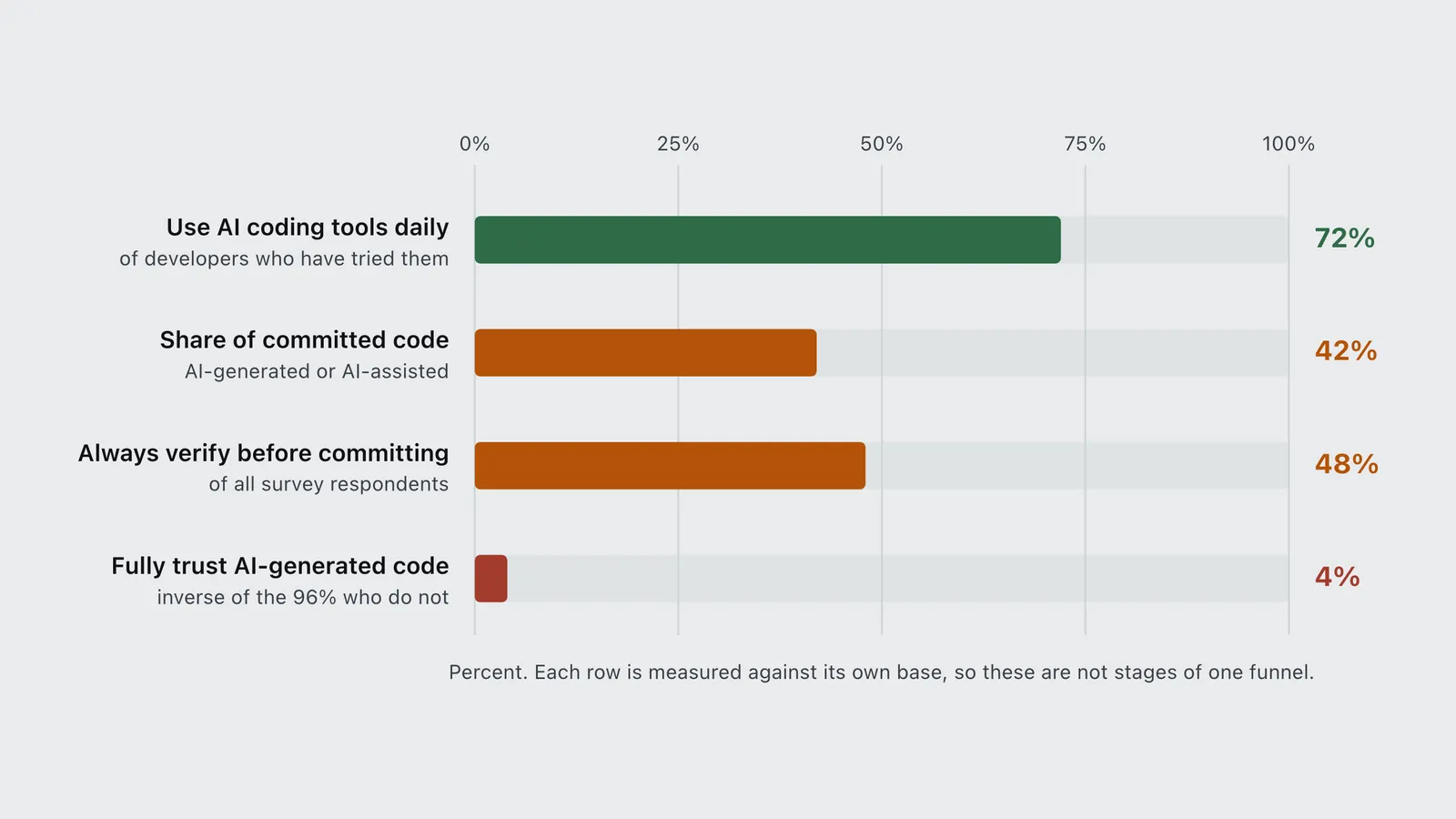
Programming with AI in 2026 is settled as a practice and unsettled as a result. Roughly 42% of committed code is now AI-generated or AI-assisted, according to Sonar’s 2026 State of Code survey of more than 1,100 professional developers, and the same survey finds 96% of those developers do not fully trust what the tools produce. The tooling question is largely answered: most working developers have picked an agent, and the comparison of the major coding agents has narrowed to two or three serious choices plus a long tail. The measurement question is not answered at all.
That gap is the story of the year. Adoption ran ahead of evidence, and the one organization running randomized controlled trials on real developers has spent 2026 reporting that its own experiment got harder to run, not easier to interpret.
Every figure below was checked against its primary source on August 15, 2026.
| Reading | Type | Change in completion time | Confidence interval |
|---|---|---|---|
| Developers forecast, before (early-2025 trial, 16 developers) | expected | −24% (faster) | not reported |
| Developers believed, after (same participants, post-trial) | perceived | −20% (faster) | not reported |
| Measured, early-2025 trial (246 real tasks, randomized) | measured | +19% (slower) | not reported |
| Measured, late-2025 agents (original cohort, 10 developers) | measured | −18% (faster) | −38% to +9% |
| Measured, late-2025 agents (newly recruited, 47 developers) | measured | −4% (faster) | −15% to +9% |
Read the top two rows against the third. In METR’s early-2025 randomized trial, 16 experienced open-source developers worked 246 real tasks in repositories they had maintained for years. They predicted AI would speed them up by 24%. Afterwards they believed it had sped them up by 20%. The measured result was that they took 19% longer. The finding that matters is not the slowdown itself, which is specific to early-2025 tools and expert maintainers on mature codebases. It is the 39-point gap between what the same people perceived and what was measured on the same tasks.
Where adoption actually landed
Adoption is no longer the interesting variable. Sonar found that 72% of developers who have tried AI coding tools now use them daily. The 2026 State of AI developer survey, fielded across roughly 6,970 respondents in its coding-agent section, found GitHub Copilot used by 67.9% and Claude Code by 62.9%, with OpenAI Codex at 34.5%. Claude Code also drew the most paying users in that survey, 3,700 against Copilot’s 2,703, which is a different signal from raw reach: Copilot arrives bundled, Claude Code has to be bought.
What is interesting is where confidence falls off as the stakes rise.
| Measure | Base | Percent |
|---|---|---|
| Use AI coding tools daily | of developers who have tried them | 72% |
| Share of committed code | AI-generated or AI-assisted | 42% |
| Always verify before committing | of all survey respondents | 48% |
| Fully trust AI-generated code | inverse of the 96% who do not | 4% |
The same pattern shows up when Sonar splits usage by what the code is for: 88% use AI on prototypes and proofs of concept, 83% on internal non-critical software, 73% on customer-facing applications, and 58% on business-critical or mission-critical services. Developers are already rationing the tools by blast radius, which is a more sophisticated response than either the boosters or the skeptics tend to credit.
There is a second split worth noting, because it contradicts how these tools are usually sold. Sonar asked which tasks AI handles well. Writing documentation scored highest at 74%, explaining and understanding existing code at 66%, and generating tests at 59%. Writing new code, the headline use case, was rated extremely or very effective by only 55% of respondents, despite 90% of them using AI for exactly that.
The measurement problem got harder, not easier
The honest summary of 2026 is that the field lost its cleanest measuring instrument.
METR ran a follow-up to the early-2025 trial, this time on late-2025 agents, with 57 developers across 143 repositories and more than 800 tasks. The headline results point the other way: the original cohort came out 18% faster, and newly recruited developers 4% faster. But the confidence intervals run from 38% faster to 9% slower, and from 15% faster to 9% slower. Both straddle zero. METR’s own characterization is that the data is “only very weak evidence” for the size of any improvement.
The reason is worth understanding, because it is going to affect every study that follows. METR published a note in February 2026 explaining why it was changing the experiment design: developers were increasingly declining to participate because they did not want to work without AI. Between 30% and 50% declined to submit particular tasks for the same reason. One participant described avoiding issues where “AI can finish things in just 2 hours, but I have to spend 20 hours.” The tasks with the largest AI uplift were being systematically filtered out of the sample by the participants themselves. METR also cut participant pay from $150/hr to $50/hr, adding a second selection effect.
The randomized trial stopped working because developers refused to give up the tool. That is itself a finding, and it is not one that shows up in any benchmark.
So the early-2025 result has not been overturned. METR treats it as still the most reliable measurement it has, while flagging that it describes early-2025 tools and says little about mid-2026 agents. What replaced it is weaker evidence pointing in a more favorable direction.
Meanwhile the self-report gap keeps reappearing. METR’s May 2026 survey of 349 technical workers found a median self-reported 1.4x to 2x change in the value of their work, with respondents estimating 1.3x in March 2025, 2x in March 2026, and forecasting 2.5x for March 2027. METR itself lists reasons for skepticism, including that its own staff, who are familiar with the perception research, give the lowest estimates of any subgroup surveyed, and that an earlier study found people overestimated AI effects by 40 percentage points on average. This site has covered the wider productivity paradox in the labor data, where the same disconnect between reported time savings and measured output shows up outside software entirely.
The practical takeaway is not that AI tools do not work. It is that self-reported speedup, which is what nearly every vendor case study and internal pilot actually measures, has a documented track record of being wrong in a consistent direction.
What actually changed in the practice
The technical story of 2026 is that the interesting work moved out of the model and into the software wrapped around it. The term that stuck is the harness: the loop, the context policy, the tool registry, the permissions, the verification gates. A February 2026 arXiv preprint by Galster, Mohsenimofidi and Lulla, Harness Engineering for Agentic AI Coding Tools: An Exploratory Study, gives the layer a working definition and applies it across Claude Code, Codex CLI, Aider, Cline, OpenHands and SWE-agent.
The evidence for why this matters is unusually clean. Holding the model fixed and changing only the harness moves scores by more than a model generation does, which this site documented in detail in the finding that identical open-weight model weights score 67.8, 77.2 and 90.0 on the same benchmark depending on the harness around them. The same principle explains why Prime Agent’s self-reported 95.5% on ARC-AGI-3 collapsed to a verified 30.2%: the harness is where both the gains and the overclaiming now live.
| Order | Technique | Lead primitive | What it removes |
|---|---|---|---|
| 1 | Context engineering | Context budget | Curate what enters the window instead of writing longer instructions |
| 2 | Agent Skills | Skills | Package procedural knowledge as loadable folders, not pasted prompt text |
| 3 | MCP servers | Tools | Give the agent reach into systems it cannot see from the filesystem |
| 4 | Subagent delegation | Subagents | Push exploratory reading into a child context so the parent stays clean |
| 5 | Verification gates | Hooks and tests | Make the agent prove the change works before it reports done |
| 6 | Spec-driven development | Specification | Treat the written spec as the artifact and the code as regenerable output |
Context engineering displaced prompt engineering
The framing that won in 2026 is that the scarce resource is not instruction quality but window space. Every tool definition, every file read, every subagent transcript is billed on every subsequent request. The practical discipline is deciding what does not enter the context, which is why the only MCP servers worth installing is a live question rather than a shopping list: past roughly 40 tools, some clients stop offering them to the model at all, and each definition is read on every turn.
Agent Skills and MCP settled into different jobs
These two are constantly conflated and they solve different problems. MCP is a connection protocol: it changes what an agent can reach. Agent Skills are a knowledge format, a folder of instructions and scripts that teaches an agent how to approach a category of work. A May 2026 arXiv preprint by Xia, Zhu and Xing, Harnessing Agent Skills: Architectural Patterns and a Reference Architecture for Skill-Mediated LLM Agents, formalizes the second category. This site keeps a full taxonomy of Skills, agent skills, MCP servers and prompt templates and a curated directory of 138 of them.
MCP itself shipped its largest revision since launch. The 2026-07-28 specification made the protocol stateless at its core, removing the initialize handshake and the session header from the Streamable HTTP transport, moving protocol version and client capabilities into per-request metadata, and making list endpoints cacheable rather than per-connection. It also hardened authorization by requiring clients to validate the issuer parameter per RFC 9207, closing an authorization-server mix-up hole, and added a formal extensions framework covering server-rendered UI and long-running tasks. The direction of travel is from “prove a common integration standard is needed” to “make it survive production.”
Spec-driven development is the process-level bet
The most disruptive of the named techniques treats a written specification as the primary artifact and the code as regenerable output. It is the rung that changes what a team reviews and what it stores in version control, which is why adoption is slower and claims about it should be treated carefully. This site keeps a fuller inventory of the named 2026 harness techniques and what each one costs, including the ratchet and loop patterns that did not fit here.
The tool landscape as of August 2026
Two things are true at once: the field consolidated around a handful of agents, and most serious teams run more than one.
| Category | Representative tools | What it is good for | Billing shape |
|---|---|---|---|
| Terminal agents | Claude Code, OpenAI Codex CLI, Gemini CLI | Heavy multi-file work, long autonomous runs | Subscription or per-token |
| IDE-native | Cursor, GitHub Copilot, Windsurf | Inline completion plus scoped agent edits | Seat plus metered credits |
| Open-source agents | OpenCode, Cline, Aider, Goose | Lower-stakes tasks, bring your own key | Model cost only |
| Platform agents | Devin, Kiro, Antigravity | Ticket-to-PR workflows inside a platform | Credits |
Rather than restate benchmark scores that move weekly and vary by effort setting, this site maintains them as tracked datasets: the value leaderboard ranking models by benchmark points per dollar, the modeled cost per finished coding task by model, and the verified subscription pricing for every major coding plan. For the tool-selection decision specifically, the 2026 AI coding agent landscape covers which agent suits which workload, and the comparison hub profiles fourteen of them side by side.
The pricing shape matters more than the sticker. Seat prices cluster tightly, but the per-task cost of running the same workload through different agents does not, and the ranking between them inverts depending on how many tokens each harness burns to finish. The cost-per-task calculator exists to make that comparison on your own assumptions rather than a vendor’s.
What the benchmarks stopped measuring
The benchmark layer is where confidence should be lowest. A June 2026 position paper by Gorinova, Baker and Heineike, Coding Benchmarks Are Misaligned with Agentic Software Engineering, argues the point directly: the tests that get quoted measure patch correctness on isolated issues, while the work being automated is multi-step, stateful and judged by whether a maintainer would merge it.
The gap is measurable. This site has covered the same model scoring 59% on “did the patch work” and 13% on “would a maintainer merge it”, the Harbor-Index results where no agent cleared 30% on 82 realistic tasks, and the three 2026 trust breaks in agent benchmarking, including a tool that scored near 100% without solving anything. Terminal-Bench, introduced in a January 2026 paper by Merrill, Shaw, Carlini and colleagues, was built specifically to cover the command-line and infrastructure work that issue-patching benchmarks do not touch, and it is now the number most agent releases lead with. The full directory of 117 benchmarks and what each actually tests is the reference version of this section.
The bill coming due
Two costs are now visible enough to plan around.
The first is security. Veracode’s Spring 2026 GenAI code security study, published March 24, 2026, ran 80 coding tasks across Java, JavaScript, C# and Python. Roughly 45% of generated samples introduced a known OWASP Top 10 flaw when no explicit security guidance was given. The distribution is lopsided: SQL injection was handled securely 82% of the time and insecure cryptography 86%, but cross-site scripting only 15% and log injection 13%. By language, Java passed securely just 29% of the time against Python’s 62%. The finding that should worry anyone planning around model upgrades is that newer and larger models showed negligible improvement, with OpenAI’s reasoning models the one outlier at 70% to 72%. A 2025 arXiv analysis by Shukla, Joshi and Syed, Security Degradation in Iterative AI Code Generation, found the related effect that iterating on generated code can make its security worse rather than better.
The second is money, and it is not the subscription. The token bill scales with how many times the harness reads the codebase, not with how many features ship, which is why the hidden cost of AI-generated code runs well past the sticker once review time and rework are counted, and why an unexpectedly large API bill usually traces to context regrowth, cache misses and retry loops rather than headline usage. Large buyers have already moved to governance: Uber and Walmart now cap per-developer AI spend rather than negotiate it down.
Sonar’s finding that 38% of developers say reviewing AI code takes more effort than reviewing a colleague’s is the link between the two costs. Review is where the security bill and the time bill are both paid, and it is the step that 52% of developers do not perform every time.
What actually works right now
Stripping out the contested claims, a defensible mid-2026 position looks like this.
Use it where the survey says it works. Documentation, code explanation and test generation rated highest with practitioners, at 74%, 66% and 59%. New feature code rated lowest of the major uses. That ordering is the opposite of how the tools are marketed and it is a reasonable place to start.
Budget context, not prompts. The highest-leverage change most teams can make is removing things from the agent’s context: fewer installed tools, shorter instruction files, exploratory reading pushed into subagents. The harness guide covering the seven extension primitives and what each costs in context is the mechanical version of this.
Make verification the harness’s job. Given that 52% of developers do not always verify before committing, and that reviewing generated code takes measurably more effort, the gate belongs in the loop rather than in the human’s discipline. The agentic workflow playbook covers plan-before-disk, verification gates and parallel worktrees as concrete recipes.
Measure with a stopwatch, not a survey. This is the single clearest lesson from the METR work. If a team wants to know whether its AI spend is working, self-reported speedup is the one instrument documented to fail.
The macro productivity dividend has not arrived
The developer-level evidence above is contested. The economy-level evidence is not, and it points the same way.
Two Bank of Korea research notes carry the clearest test. BOK Issue Note 2025-22, Rapid Adoption of Artificial Intelligence and Its Productivity Effects: The Case of Korea (Suh, Oh and Kim, November 2025) surveyed 5,512 employed Koreans and found 63.5% using generative AI in some form and 51.8% using it for work, close to double the United States work-use rate. Korea is one of the most AI-saturated workforces measured anywhere, which makes it the cleanest available test: if a productivity dividend exists, it should surface there first. The survey put time saved at 3.8% of a 40-hour week, and the estimated gain if every saved minute became output at roughly 1.0%. The follow-up, BOK Issue Note 2026-12, Does AI Adoption Improve Productivity? Effects Over the First Three Years (Suh, Oh and Yoon, 2026), found the realised correlation with output close to zero.
The independent evidence lines up. NBER Working Paper 34984 (2026, a working paper, not peer reviewed) surveyed roughly 6,000 corporate executives across four countries and reports about 90% seeing no productivity impact from AI over three years.
This has a precedent worth naming. In 1987 Robert Solow wrote that “you can see the computer age everywhere but in the productivity statistics.” The gap lasted most of a decade before the numbers moved. The lesson was not that computers were useless: a general-purpose technology pays off only once the work around it is rebuilt, and productivity tracked the reorganisation rather than the hardware. AI is running the same play. The tool is in everyone’s hands; the workflows, incentives and reporting structures that would turn a faster draft into a larger result are mostly untouched.
Bottom line
Programming with AI in 2026 is a practice with near-universal adoption, a well-developed technique stack, a maturing protocol layer, and an evidence base that is thinner than the adoption curve implies. The tools work well enough that developers will not give them up, which is documented literally: METR had to redesign an experiment because participants refused to work without them. Whether they make experienced developers faster on hard tasks in familiar codebases remains, as of August 2026, an open question with a large measured perception gap attached to it.
The practical posture that follows is neither adoption nor skepticism. It is instrumentation. Pick the agent on cost per finished task rather than benchmark score, spend the effort on context and verification rather than prompts, and measure outcomes with something other than how fast the work felt.
Frequently asked questions
- What percentage of code is written by AI in 2026?
- Sonar’s 2026 State of Code survey of more than 1,100 professional developers found that 42% of committed code is AI-generated or AI-assisted, and developers expect that share to reach 65% by 2027. This is a self-reported survey figure rather than an instrumented measurement of repositories.
- Does AI actually make developers faster?
- The evidence is contested. METR’s randomized controlled trial of 16 experienced open-source developers on 246 real tasks measured them 19% slower with early-2025 AI tools, while the same developers believed they were 20% faster. A 2026 follow-up on later agents measured speedups of 4% to 18%, but with confidence intervals that straddle zero and severe selection effects that METR itself flags. No clean measured answer exists for mid-2026 tools.
- What is context engineering?
- Context engineering is the discipline of deciding what information enters an agent’s context window, rather than writing better instructions for the model. It matters because every tool definition, file read and subagent transcript is billed on every subsequent request, so removing material is often higher-leverage than adding it. It displaced prompt engineering as the primary technique framing during 2026.
- What is the difference between MCP and Agent Skills?
- They solve different problems. The Model Context Protocol is a connection protocol that changes what an agent can reach, such as a database, an API or an external service. Agent Skills are a knowledge format, a folder of instructions and scripts that teaches an agent how to approach a category of work. A team can need both, and neither replaces the other.
- Is AI-generated code less secure?
- Veracode’s Spring 2026 study ran 80 coding tasks across four languages and found roughly 45% of generated samples introduced an OWASP Top 10 flaw when no security guidance was given. The failure rate varies sharply by vulnerability class: SQL injection was handled securely 82% of the time, cross-site scripting only 15%. Newer and larger models showed negligible improvement, which means waiting for a better model is not a security strategy.
- Which AI coding agent is the most used in 2026?
- The 2026 State of AI developer survey found GitHub Copilot used by 67.9% of respondents and Claude Code by 62.9%, with OpenAI Codex at 34.5%. Claude Code drew more paying users than Copilot in the same survey, 3,700 against 2,703, which reflects that Copilot often arrives bundled while Claude Code is bought deliberately.
- Why do coding benchmarks disagree with real-world results?
- A June 2026 position paper argues that widely quoted benchmarks measure patch correctness on isolated issues while the work being automated is multi-step, stateful and judged on whether a maintainer would merge the result. The same model has scored 59% on whether a patch works and 13% on whether it would be merged. Harness choice alone can move scores by more than a model generation.
Sources
- Suh, D., Oh, S., and Kim, M. (2025). Rapid Adoption of Artificial Intelligence and Its Productivity Effects: The Case of Korea. BOK Issue Note 2025-22, Bank of Korea. Survey of 5,512 employed Koreans; the 63.5% adoption, 51.8% work-use, 3.8% time saved and ~1.0% potential gain figures.
- Suh, D., Oh, S., and Yoon, J. (2026). Does AI Adoption Improve Productivity? Effects Over the First Three Years. BOK Issue Note 2026-12, Bank of Korea.
- National Bureau of Economic Research (2026). Artificial Intelligence, Productivity, and the Workforce: Evidence from Corporate Executives. NBER Working Paper 34984 (working paper, not peer-reviewed).
- Sonar (2026). State of Code Developer Survey report: The current reality of AI coding. Sonar. Survey of 1,100+ professional developers; the 42% AI-written share, the 65% 2027 projection, 72% daily use, 96% incomplete trust, 48% always verify, 38% harder review, the effectiveness ratings and the project-type split. Verified August 15, 2026.
- METR (2025). Measuring the Impact of Early-2025 AI on Experienced Open-Source Developer Productivity. METR research report, with preprint at arXiv:2507.09089. The 19% measured slowdown, 16 developers, 246 tasks, the 24% forecast and 20% post-trial belief. Verified August 15, 2026.
- METR (2026). We are Changing our Developer Productivity Experiment Design. METR. The 57-developer, 143-repo, 800+ task follow-up; the 18% and 4% point estimates with their confidence intervals; the selection effects, the 30-50% task declines and the pay change. Verified August 15, 2026.
- METR (2026). Measuring the Self-Reported Impact of Early-2026 AI on Technical Worker Productivity. METR. 349 respondents, the 1.4x to 2x median, the 1.3x/2x/2.5x trajectory, and METR’s own stated reasons for skepticism including the 40-percentage-point overestimate finding. Verified August 15, 2026.
- Veracode (2026). Spring 2026 GenAI Code Security Update. Veracode, published March 24, 2026. 80 coding tasks across four languages, the ~45% OWASP flaw rate, the per-language and per-CWE breakdowns, and the finding that newer models did not improve materially. Verified August 15, 2026.
- Model Context Protocol (2026). Key Changes, 2026-07-28 specification. modelcontextprotocol.io. The stateless protocol core, removal of the initialize handshake and session header, per-request metadata, cacheable list endpoints, RFC 9207 issuer validation and the extensions framework. Verified August 15, 2026.
- State of AI (2026). Agents and Assistants. 2026.stateofai.dev. Roughly 6,970 respondents in the coding-agent section; Copilot 67.9%, Claude Code 62.9%, Codex 34.5%, and the paying-user counts. Verified August 15, 2026.
- Galster, M., Mohsenimofidi, S., Lulla, J. L., et al. (2026). Harness Engineering for Agentic AI Coding Tools: An Exploratory Study. arXiv preprint 2602.14690, submitted February 16, 2026. The working definition of the harness layer. Verified August 15, 2026.
- Xia, B., Zhu, L., Xing, Z., et al. (2026). Harnessing Agent Skills: Architectural Patterns and a Reference Architecture for Skill-Mediated LLM Agents. arXiv preprint 2606.20631, submitted May 29, 2026. Agent Skills as a distinct architectural category. Verified August 15, 2026.
- Gorinova, M. I., Baker, M., Heineike, A., et al. (2026). Position: Coding Benchmarks Are Misaligned with Agentic Software Engineering. arXiv preprint 2606.17799, submitted June 16, 2026. The benchmark-misalignment argument. Verified August 15, 2026.
- Merrill, M. A., Shaw, A. G., Carlini, N., et al. (2026). Terminal-Bench: Benchmarking Agents on Hard, Realistic Tasks in Command Line Interfaces. arXiv preprint 2601.11868, submitted January 17, 2026. Terminal-Bench scope and construction. Verified August 15, 2026.
- Shukla, S., Joshi, H., Syed, R. (2025). Security Degradation in Iterative AI Code Generation: A Systematic Analysis of the Paradox. arXiv preprint 2506.11022. Security degradation across generation iterations. Verified August 15, 2026.
Related Capital and Compute coverage referenced above: the AI coding agents comparison hub, the 2026 AI coding agent landscape, harness engineering techniques, the Claude Code harness guide, the agentic workflow playbook, Skills versus MCP versus prompts, the agent skills and MCP directory, why local models fail agentic coding, Prime Agent and the verified-score gap, agent benchmark trust breaks, Harbor-Index, DeepSWE versus FrontierCode, the benchmarks directory, the value leaderboard, cost per finished task, coding plan pricing, the cost-per-task calculator, the model release tracker, the hidden cost of AI-generated code, why API bills run high, enterprise token caps, the MCP server shortlist and the AI productivity paradox.